Inside the product, distribution, economics, and evidence behind one of the fastest AI startup exits of the recent vibe-coding boom.
Quick Snapshot
| Business | Base44 |
| Founder | Maor Shlomo |
| Category | AI App Builder / Vibe Coding |
| Started | Late 2024 |
| Business Model | Freemium SaaS |
| Initial Users | 3 close friends |
| Funding Before Acquisition | Bootstrapped |
| Acquirer | Wix |
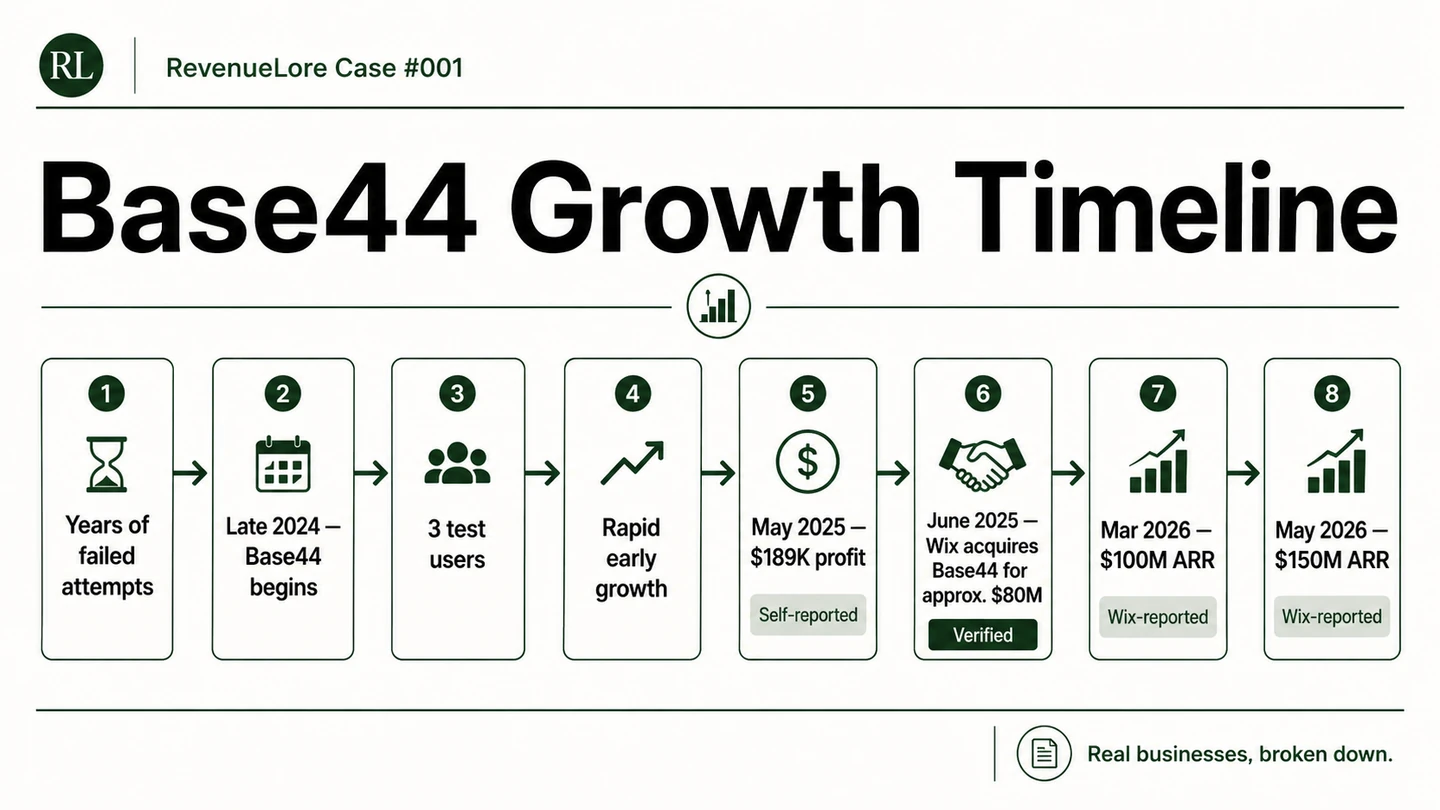
| Acquisition Announced | June 18, 2025 |
| Initial Consideration | Approx. $80 million |
| Verification | Acquisition: Verified / Early financial metrics: Founder-reported |
The Short Version
Base44 began with Maor Shlomo sitting around a table with three non-technical founders who were also close friends. They would attempt to build something with the product. When it broke, Shlomo watched what went wrong, fixed it, and had them try again.
Roughly six months later, Wix acquired Base44 for approximately $80 million in initial consideration, with additional performance-based payments possible through 2029. Wix also disclosed that roughly $25 million of the initial consideration would be used for employee retention bonuses.
The headline is extraordinary. The more useful story is what happened in between.
Base44 combined a problem its founder had spent years thinking about, unusually favorable AI timing, exceptionally close early-user feedback, rapid iteration, and organic distribution. It is also a useful reminder of why startup stories need verification. Some of Base44’s most impressive early financial and user metrics came from the founder himself, while the acquisition terms were independently disclosed by Wix. Those two categories of evidence are not equivalent.
1. What Was Base44?
Base44 is an AI-powered platform that lets users describe software in ordinary language and have the system build a working application. It does more than generate a visual interface: the platform can handle components such as the frontend, database, authentication, user permissions, data storage, and hosting. Base44’s current documentation describes it as a tool that allows people without coding skills to build anything from internal dashboards and booking systems to CRMs and full products.
The basic promise is simple:
Instead of buying software or hiring someone to build it, describe what you need and let AI create it.
That promise became especially attractive as large language models made increasingly complex software generation possible.
2. The Idea Was Not Actually New to the Founder
One of the easiest ways to tell the Base44 story badly is to say:
“A founder saw the AI trend, built an app, and sold it six months later for $80 million.”
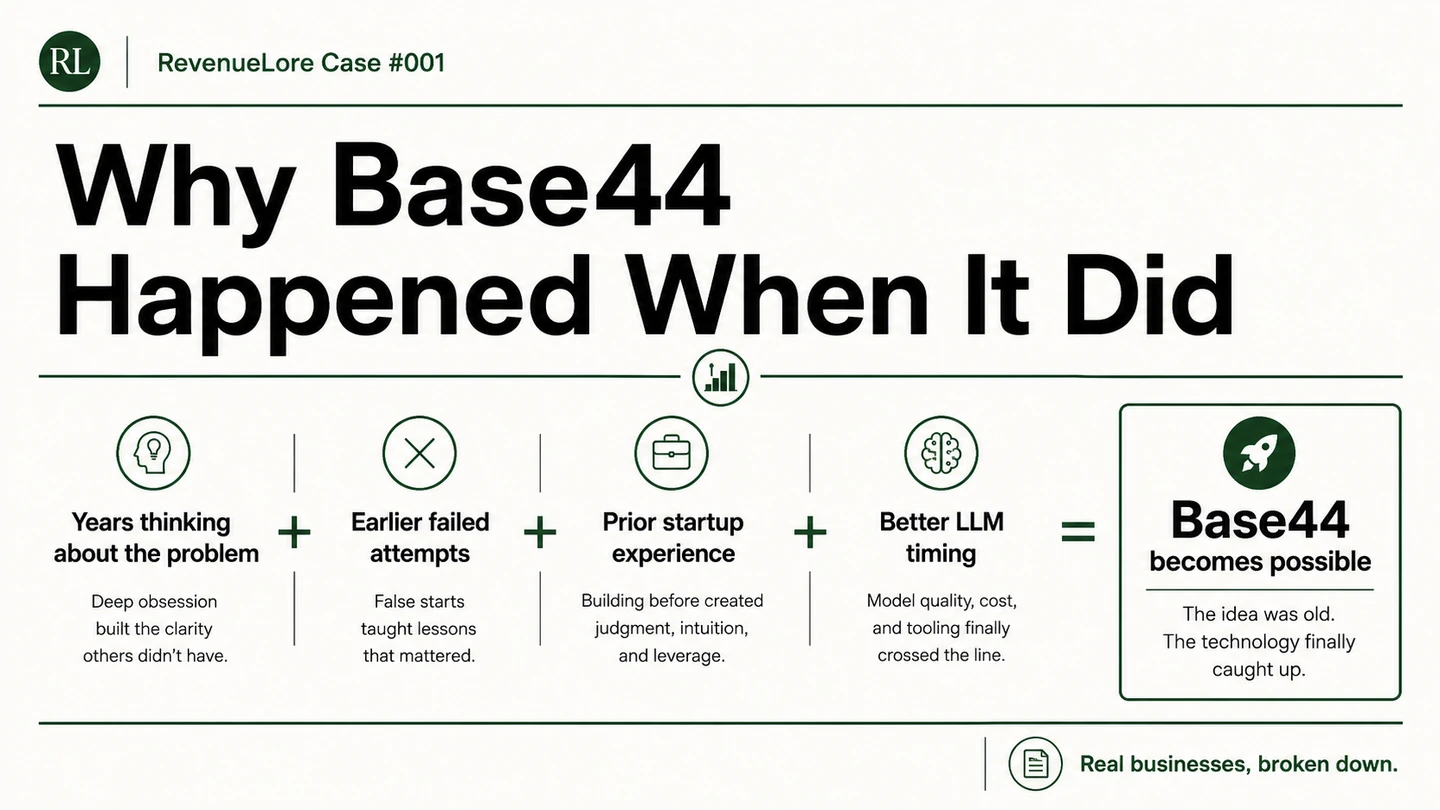
That skips an important part. Shlomo said he had been thinking about this kind of product for years and had attempted multiple earlier versions that failed. According to his own account, advances in large language models finally made the idea technically feasible in a way that previous attempts were not. Base44 was not simply the result of reacting quickly to a trend. The founder already understood the problem and had tried, and failed, to solve it before.
The technology caught up with an old idea. That is a very different founder story.
3. His First Market Was Three People
Base44 did not begin with a large launch. Shlomo says he started with three close friends: solo founders, non-technical, trying to build businesses quickly, and unable to implement their own product ideas. Rather than sending them a beta link and waiting for analytics, Shlomo sat with them in person. He watched them use Base44. When something failed, he fixed it. Then they tried again.
The initial goal was not Get 10,000 users. It was Make three people genuinely want to keep using the product. Shlomo said he did not want to scale distribution until users were enjoying the product enough to start sharing it with other people on their own.
4. What Problem Did Base44 Solve?
The target user had an idea but lacked the engineering capacity to turn it into software. Traditionally, that person had several options: hire developers, find a technical co-founder, use multiple no-code products, wait for internal engineering resources, or continue using spreadsheets and manual processes.
Base44 compressed those steps. A user could describe the intended application in natural language and allow the platform to handle much of the technical infrastructure, reducing one of the largest barriers between “I know what I need” and “I have working software.” Base44’s current product continues to position itself around exactly this idea, with integrated backend systems, databases, authentication, hosting, and natural-language app generation all included.
5. How Did Base44 Make Money?
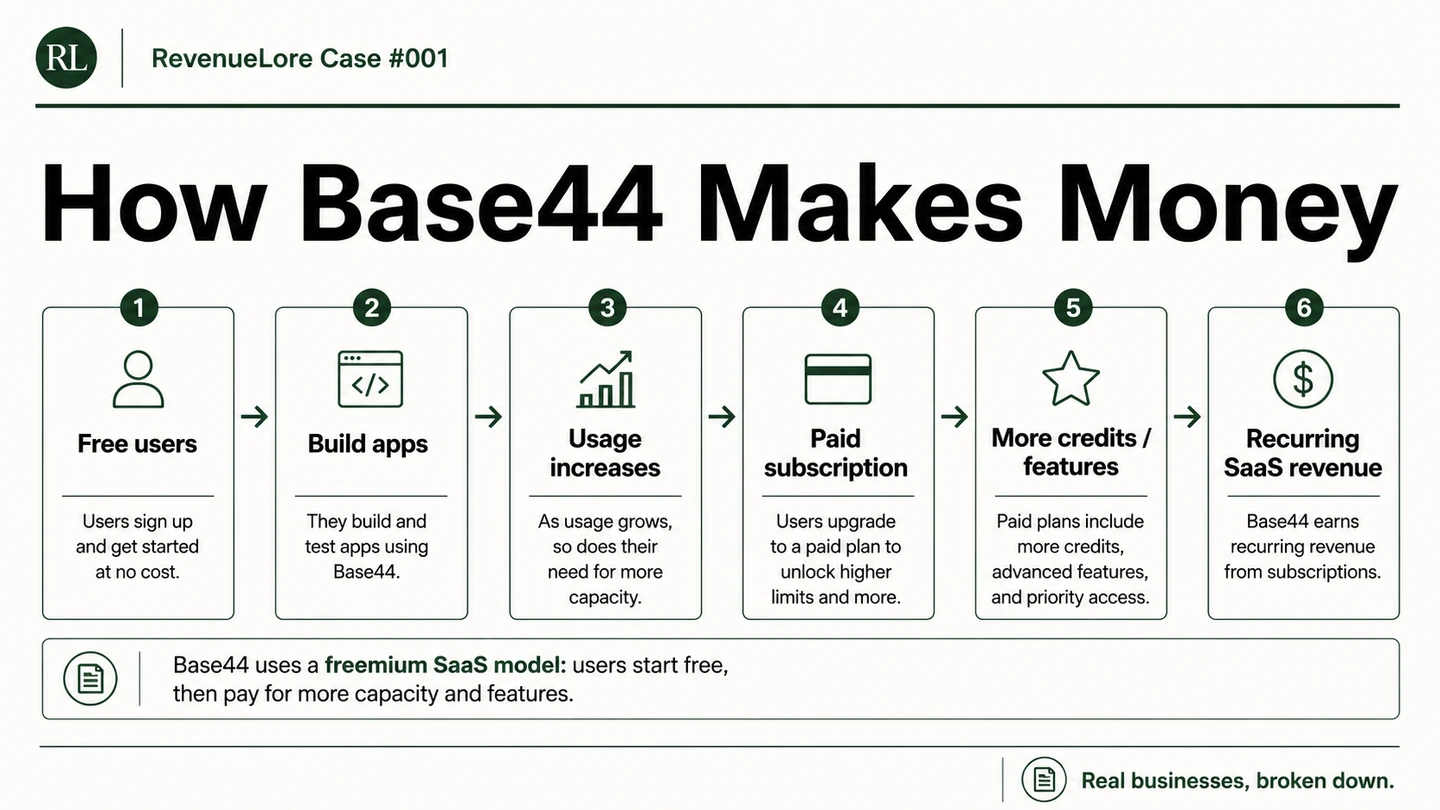
Base44 operates as a freemium SaaS business. Users can begin for free and pay for additional capacity and features. As of 2026, the platform offers a free tier alongside paid Starter, Builder, Pro, and Elite plans. Annual-billing prices currently range from $16 per month to $160 per month, with usage governed by message and integration credits.
Current pricing is verified.
The exact historical pricing mix that produced Base44’s early 2025 revenue has not been reconstructed from primary archival evidence in this case study.
We should not assume today’s plans perfectly represent the economics of the business before the Wix acquisition.
6. Was Base44 Actually Profitable?
Shlomo publicly reported that Base44 generated $189,000 in profit in May 2025. He attributed the result partly to faster-than-expected growth and falling LLM costs, and said affiliate activity was contributing traffic and revenue. TechCrunch reported the same figure while explicitly attributing it to Shlomo’s public posts.
SELF-REPORTED
That does not mean the number is false. It means we have not found independent audited financial statements proving that specific monthly profit figure, and the sourcing should be read accordingly.
7. How Did Base44 Get Customers?
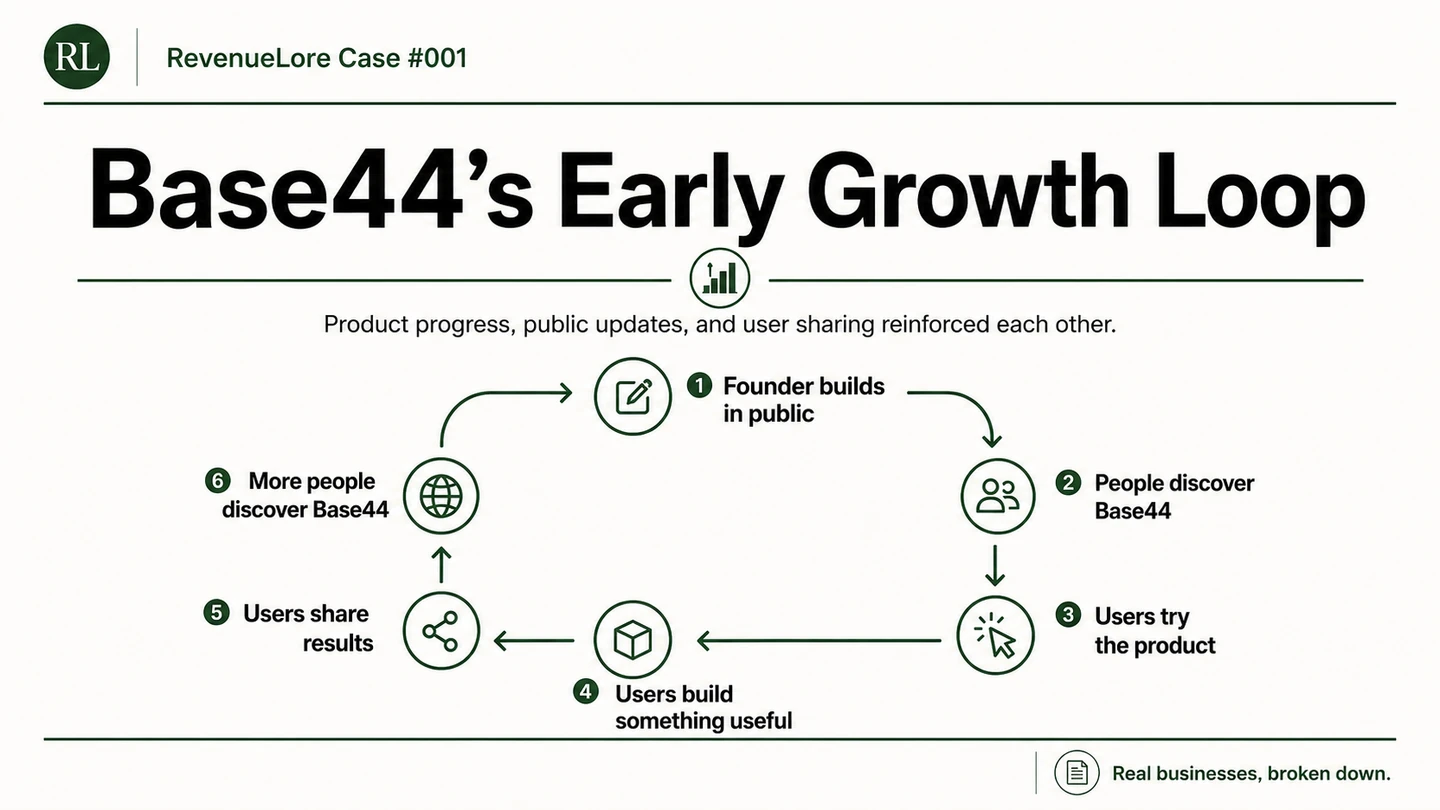
The early work served product development rather than scale. Shlomo used the first three users to understand where they struggled, watching their behavior directly and iterating around the problems he saw. He treated organic sharing as the signal that the product was ready to travel beyond that small group, rather than trying to force distribution first.
He also documented Base44’s development publicly on LinkedIn and X. TechCrunch reported that the product spread largely through word of mouth while he shared the building process openly. That made the product story part of the distribution: milestones generated posts, posts drew attention, attention brought in users, and those users supplied further product feedback.
8. How Fast Did It Grow?
This is where the evidence becomes less clean. TechCrunch reported that Base44 reached roughly 250,000 users by the acquisition, after reportedly reaching 10,000 users within the first three weeks. In a later founder interview, Shlomo described the business as having grown beyond 400,000 users. These figures may refer to different measurement dates or definitions.
Base44 clearly experienced very rapid user growth. What the available evidence does not support is treating one reported user count as the definitive figure for every point in the acquisition timeline.
9. Was It Really a One-Person Company?
For most of its early life, Base44 was closely associated with Shlomo operating as a solo founder. But the viral description of an “$80 million one-person startup” is incomplete. TechCrunch reported that Wix confirmed Base44 had eight employees at the time of acquisition. In a post-acquisition interview, Shlomo indicated that hiring began roughly a month and a half before the deal.
Base44 was bootstrapped and built largely by a solo founder during its critical early growth period, but it was not literally a one-person company when Wix acquired it.
That caveat keeps the shorthand in proportion for anyone drawing lessons from the story.
10. Why Did Wix Pay Approximately $80 Million?
Wix announced the acquisition on June 18, 2025. The official transaction terms specified approximately $80 million of initial consideration, plus additional earn-out payments through 2029 based on performance metrics.
Strategically, the combination makes sense. Wix had spent years helping non-technical users create websites; Base44 extended that philosophy into creating software applications through natural language. Wix said Base44 would remain a distinct product while gaining access to Wix’s scale and resources. This was not simply the acquisition of an interesting AI demo. Wix was buying a rapidly growing entry point into AI-generated software.
11. What Happened After the Acquisition?
The story did not end with the $80 million announcement. In March 2026, Wix said Base44 had reached $100 million in ARR. By May 2026, Wix reported Base44 at approximately $150 million in ARR. These figures come from Wix’s own financial reporting rather than from an anonymous estimate, and they suggest Wix did not simply buy a short-lived viral product. Base44 continued scaling rapidly after the acquisition.
12. Why Did Base44 Work?
The following section is RevenueLore analysis, not a direct statement from the company. We see five major factors.
1. Founder–Problem Fit
Shlomo did not discover the problem six months before the exit. He says he had investigated and attempted versions of the idea for years. That gave him a deeper understanding of the user problem than someone simply chasing an AI trend.
2. Exceptional Timing
The idea became dramatically more feasible as LLM capabilities improved. A previously difficult product suddenly became buildable. The market also became more comfortable with AI-generated software.
3. Tiny Initial Customer Set
Instead of optimizing for traffic, Base44 initially optimized for three people. This allowed rapid feedback without the noise of a large audience.
4. Speed
AI was not only the product. It also increased the founder’s ability to build and iterate quickly. That helped a bootstrapped company compete in a category containing heavily funded competitors.
5. Distribution Was Attached to the Product Story
Building in public transformed product development into marketing. Users, product updates, founder posts, and word of mouth reinforced each other. TechCrunch specifically identified word of mouth and Shlomo’s public build journey as major elements of Base44’s spread.
13. What New Founders Should Not Learn From Base44
Exceptional outcomes create dangerous lessons. The wrong takeaway is:
“Use AI, build an app quickly, and someone may buy it for $80 million.”
Base44 had several advantages that are difficult to reproduce: a technically experienced founder, previous startup experience, years of thinking about the problem, rapidly improving underlying AI technology, unusually strong market timing, organic distribution, and a strategic acquirer whose existing business closely matched the product. The acquisition should be treated as an outlier result. The process, however, contains repeatable lessons.
14. What Can We Actually Learn?
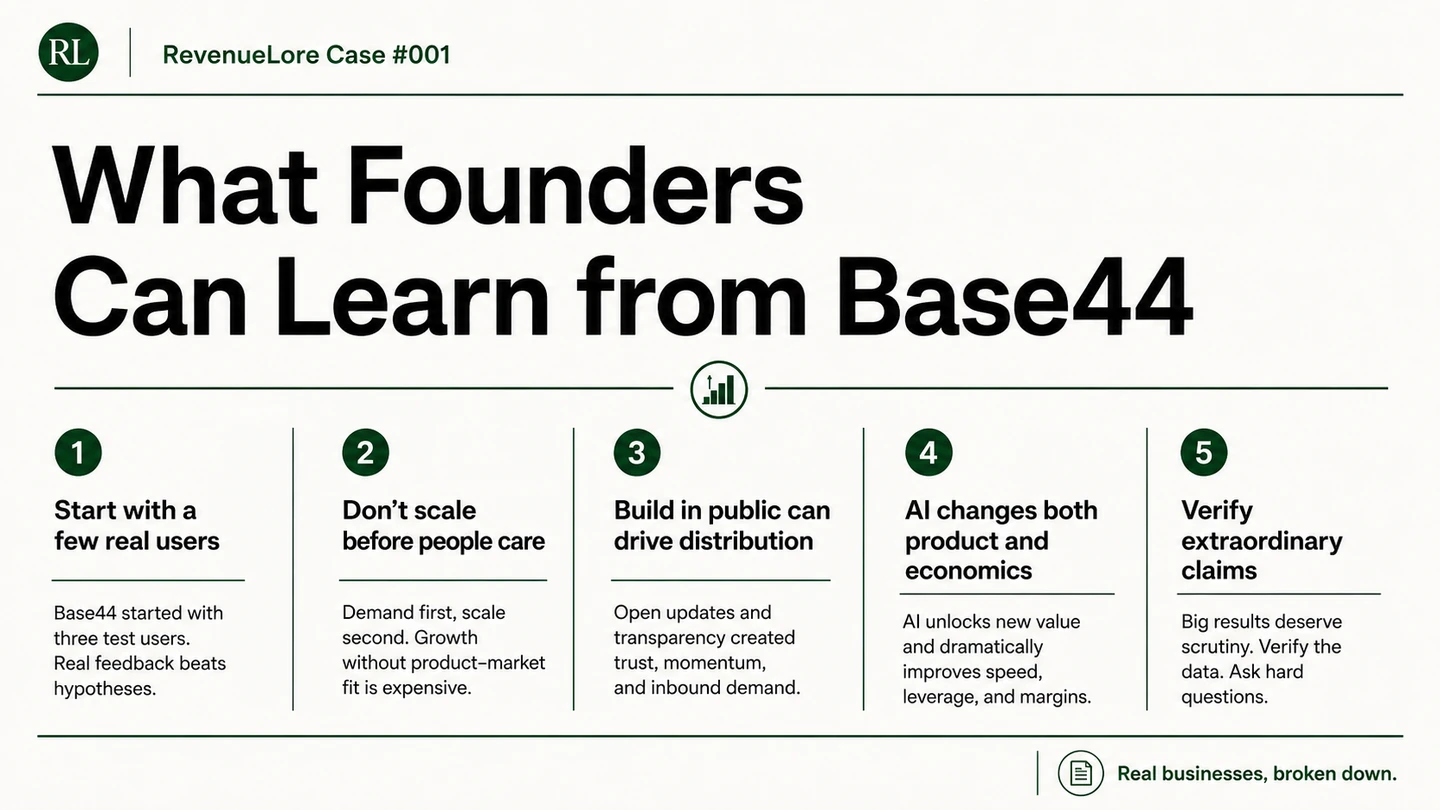
Start with people, not traffic
Three highly engaged test users can teach more than thousands of low-intent visitors. Shlomo’s in-person observation of his first three friends gave him direct feedback as they encountered failures and he fixed the product before asking them to try again.
A failed old idea can become a good new idea
Technology changes what is commercially possible. Shlomo had attempted earlier versions of this product before advances in large language models made the idea technically feasible. Timing mattered.
Do not scale before people naturally want to share
Shlomo waited for organic sharing before widening distribution. Distribution cannot permanently compensate for a product users do not value.
The founder’s public journey can become a distribution channel
Building in public works best when there is genuinely interesting progress to share. Milestone posts and transparent updates attracted users who then fed back into the product loop.
AI can change company economics, not just product features
Base44 demonstrates how AI can affect both what a company sells and how quickly a small team can build it.
Verify spectacular numbers
Founder-reported revenue is not the same type of evidence as an acquisition disclosed by a public company. That difference should always be visible to the reader.
15. Verification Notes
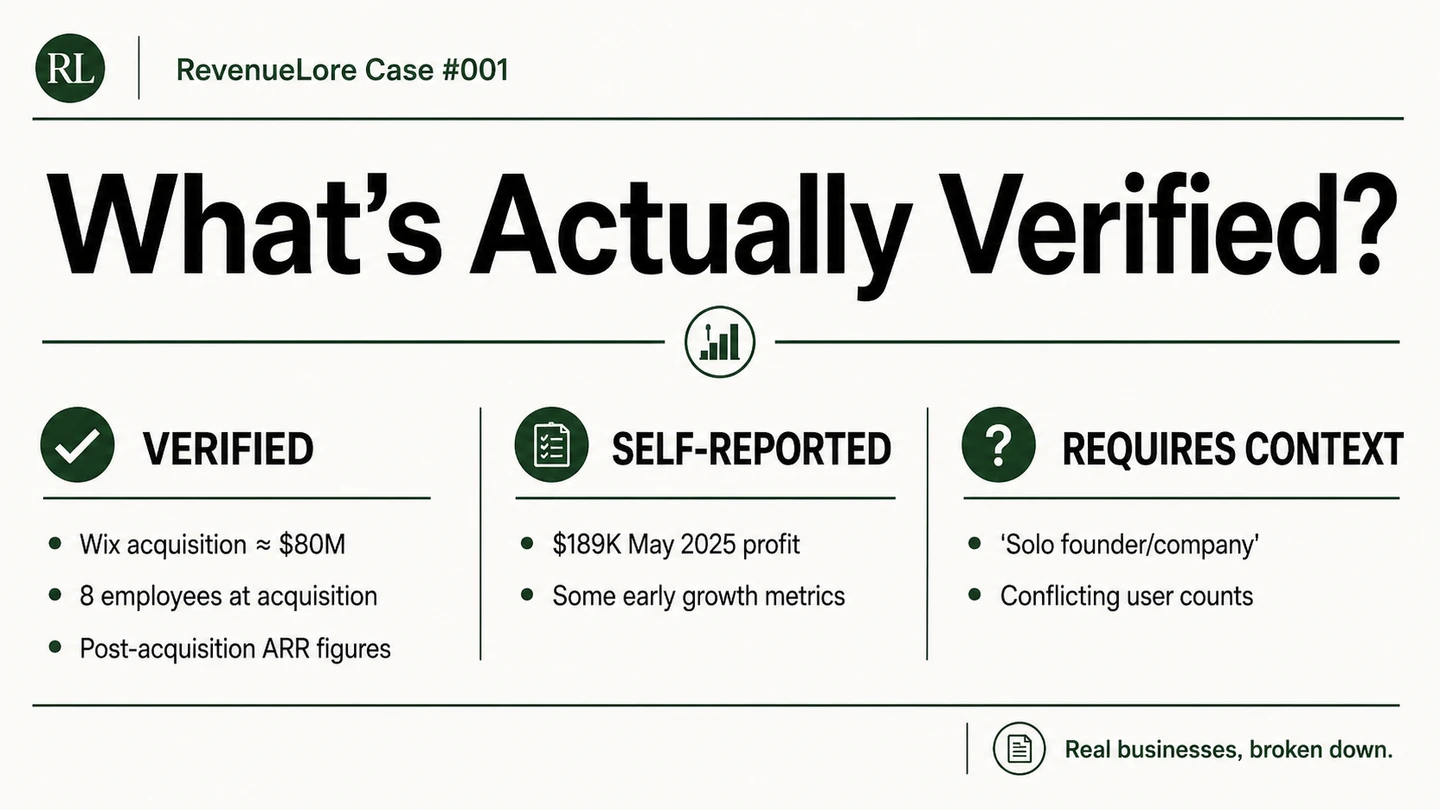
VERIFIED
Wix acquisition: Approximately $80 million in initial consideration, with additional performance-based earn-outs through 2029.
Employees at acquisition: TechCrunch reported Wix confirmed eight employees.
Post-acquisition ARR: Wix reported approximately $100 million ARR in March 2026 and approximately $150 million ARR by May 2026.
FOUNDER-REPORTED / SUPPORTED
First three users: Described directly by Shlomo.
$189,000 May 2025 profit: Reported publicly by Shlomo and repeated by TechCrunch.
REQUIRES CONTEXT
“Solo founder”: Accurate for much of the early build, but not literally true at acquisition because the company had employees.
User counts: Multiple reported figures exist at different points in the timeline, so they should not be treated as one fixed acquisition-date number.
RevenueLore Takeaway
Base44 is memorable because of the $80 million acquisition. But that is not the most useful part of the story.
The useful sequence is much smaller:
Understand a problem deeply.
Wait for technology to make the right solution possible.
Find a handful of real users.
Watch them struggle.
Fix the product.
Do not chase scale before users care.
Let real progress become distribution.
The outcome was exceptional. The early process was surprisingly ordinary. And that may be the most valuable signal in the entire Base44 story.
Primary & Key Sources
- Wix — Base44 acquisition announcement and transaction terms.
- Base44 — Current product documentation and pricing.
- Maor Shlomo — Early-user and product-development account.
- Maor Shlomo / Lenny Rachitsky interview — Solo-founder timeline and first-user process.
- TechCrunch — Acquisition, employees, growth and reported profitability.
- Wix financial results — Post-acquisition ARR updates.