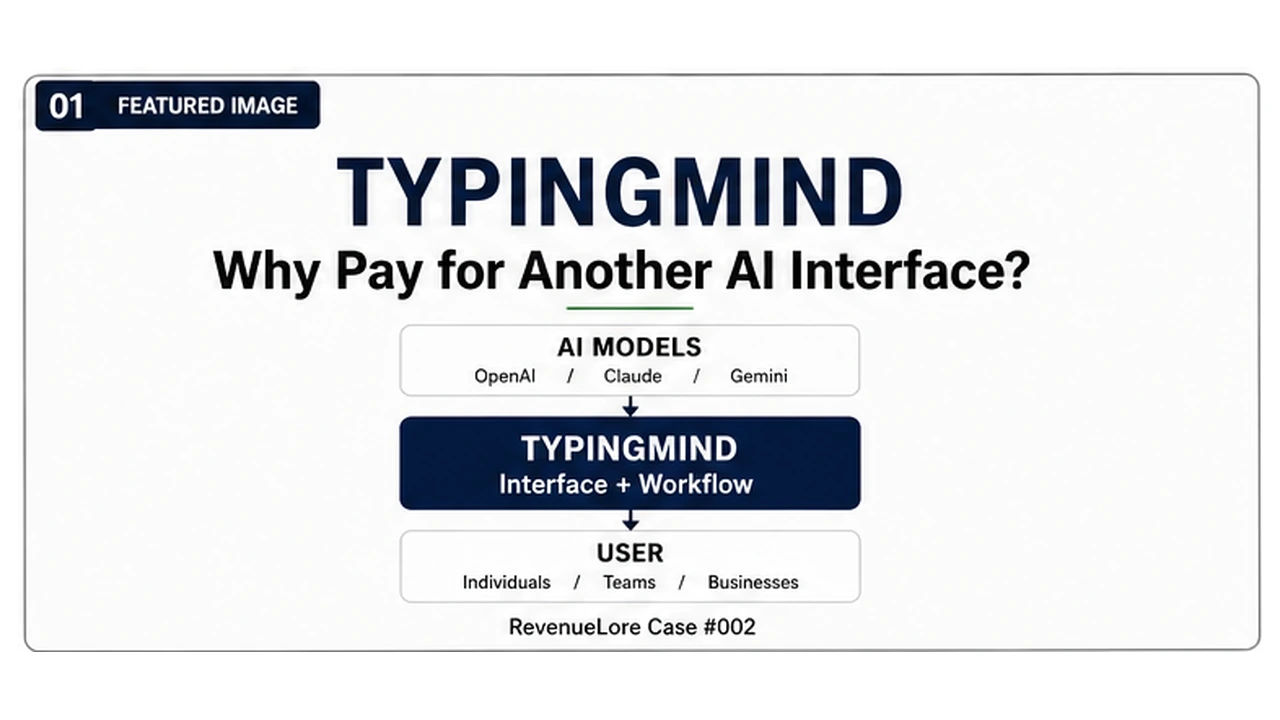
Tony Dinh did not build another foundation model. He built a better way to use one.
TypingMind began only days after OpenAI opened API access to GPT-3.5 Turbo in March 2023. Dinh was already a heavy ChatGPT user, and he saw an opportunity in something much less ambitious than replacing OpenAI: improving the experience around its model.
What followed became one of the more interesting examples of an independent business built on top of the generative-AI boom.
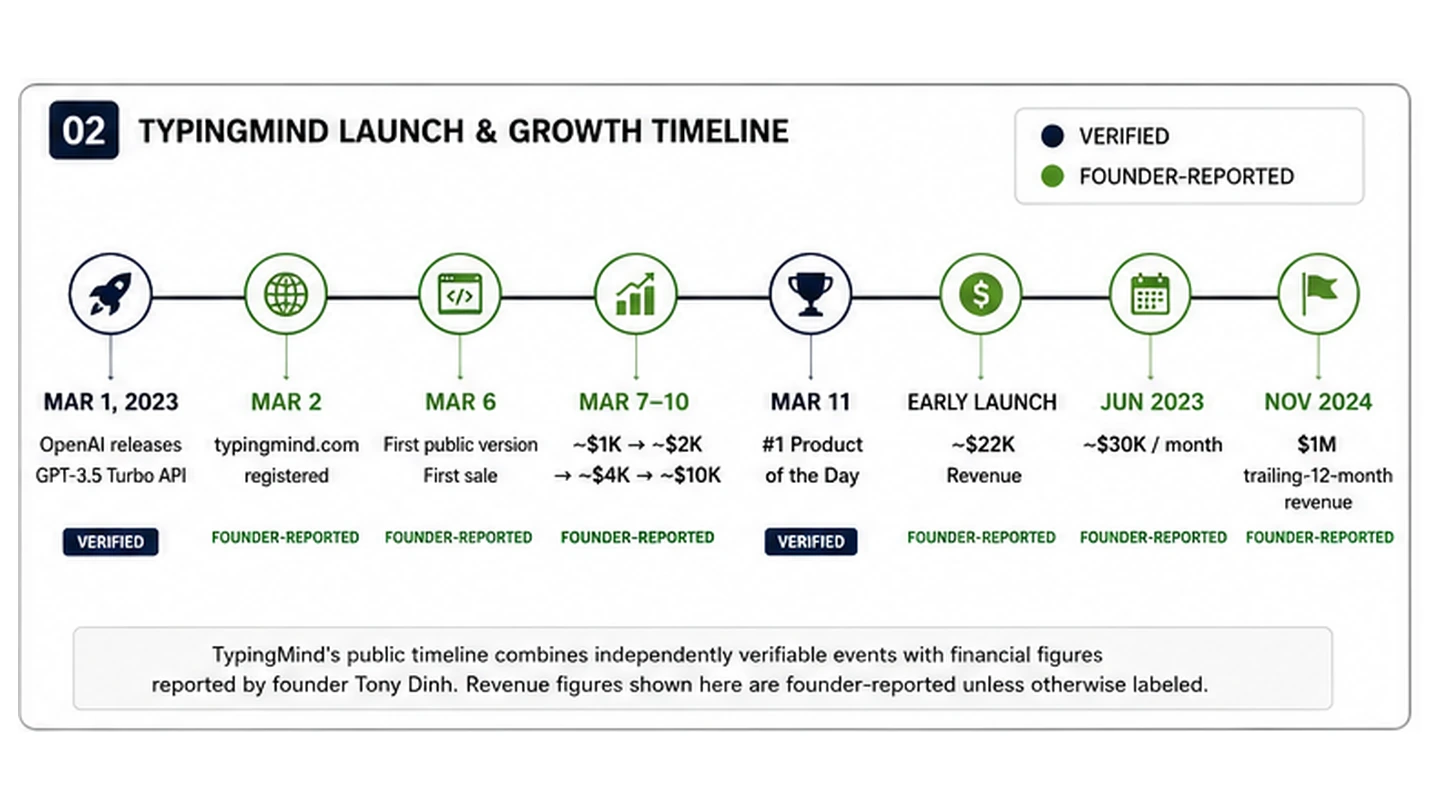
Dinh says TypingMind generated roughly $22,000 in early launch revenue, reached about $30,000 per month by June 2023, and later generated $1 million over a trailing 12-month period by November 2024.
Those numbers are important, but so is their provenance: they are founder-reported, not independently audited financial results.
The more useful question is not how impressive the first revenue spike was.
It is this:
Why were people willing to pay for TypingMind when ChatGPT already existed?
Quick Snapshot
| Business | TypingMind |
| Founder | Tony Dinh |
| Category | LLM Frontend / AI Workspace |
| Started | March 2023 |
| Initial Product | Alternative interface for using ChatGPT through the API |
| Initial Paid Price | $9 |
| Initial Distribution | Primarily Tony Dinh’s Twitter/X audience |
| Early Revenue | ~$22K during the launch period — founder-reported |
| June 2023 Revenue | ~$30K/month — founder-reported |
| 2024 Milestone | $1M over the previous 12 months — founder-reported |
| Personal Business Model | One-time software license + user-paid API usage |
| Teams Business Model | Recurring subscription |
| Verification | Current product/pricing facts verified; most historical financial metrics founder-reported |
The Short Version
When OpenAI released the GPT-3.5 Turbo API on March 1, 2023, Dinh was already using ChatGPT heavily. He liked what the model could do but disliked parts of the experience around it, including repeated logins, response speed and limited tools for organizing conversations.
The API changed what he could do about those problems. Instead of waiting for ChatGPT itself to improve, he could build another interface around the underlying model.
Dinh registered typingmind.com the following day. On March 6, according to his own account, he released the first public version and made his first sale after adding a paid option.
Revenue then rose quickly. Dinh later reported roughly $1,000, $2,000 and $4,000 in cumulative revenue over successive days, reaching around $10,000 by March 10 in his retrospective. TypingMind launched on Product Hunt on March 11 and finished #1 Product of the Day, an event that can be independently verified through Product Hunt’s historical records.
Dinh reported roughly $22,000 in total early launch revenue.
There was another important factor behind those numbers: he already had an audience.
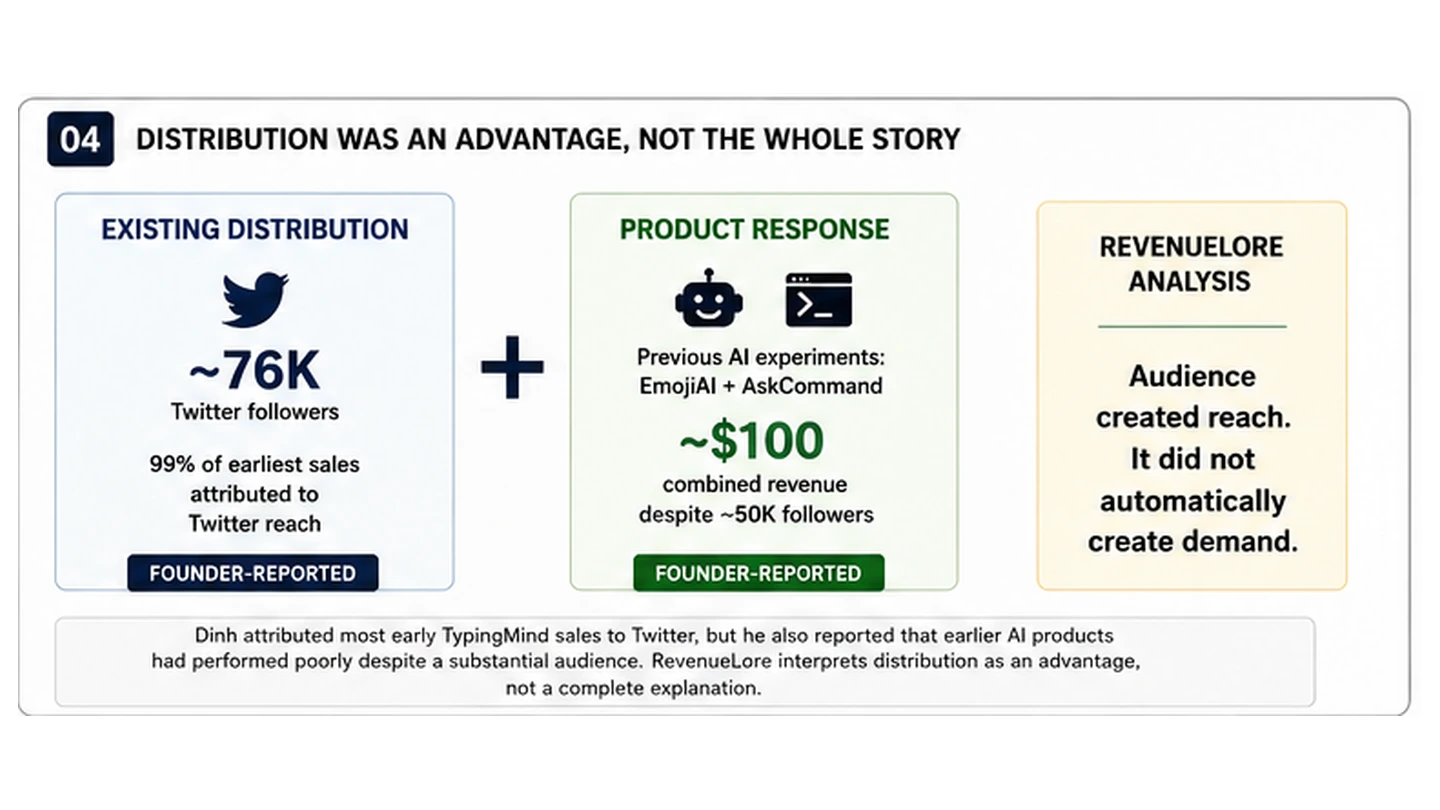
Dinh said he had roughly 76,000 Twitter followers and attributed around 99% of TypingMind’s earliest sales to his Twitter reach.
Yet the audience alone does not explain the outcome. He had previously launched other AI products while already having tens of thousands of followers and said those experiments generated almost no meaningful revenue.
TypingMind becomes more useful as a business case when those factors are considered together: an experienced builder, existing distribution, exceptional timing and a product that solved a problem customers appeared willing to pay to remove.
1. TypingMind Was Selling the Layer Around the Model
TypingMind is an interface for working with large language models.
The product evolved considerably after its original launch. At the time of RevenueLore’s August 2026 source review, TypingMind allowed users to work with models from multiple providers through one interface while supplying their own API credentials. It also offered features around prompts, agents, projects, plugins and broader workflow management.
That makes its position in the technology stack important.
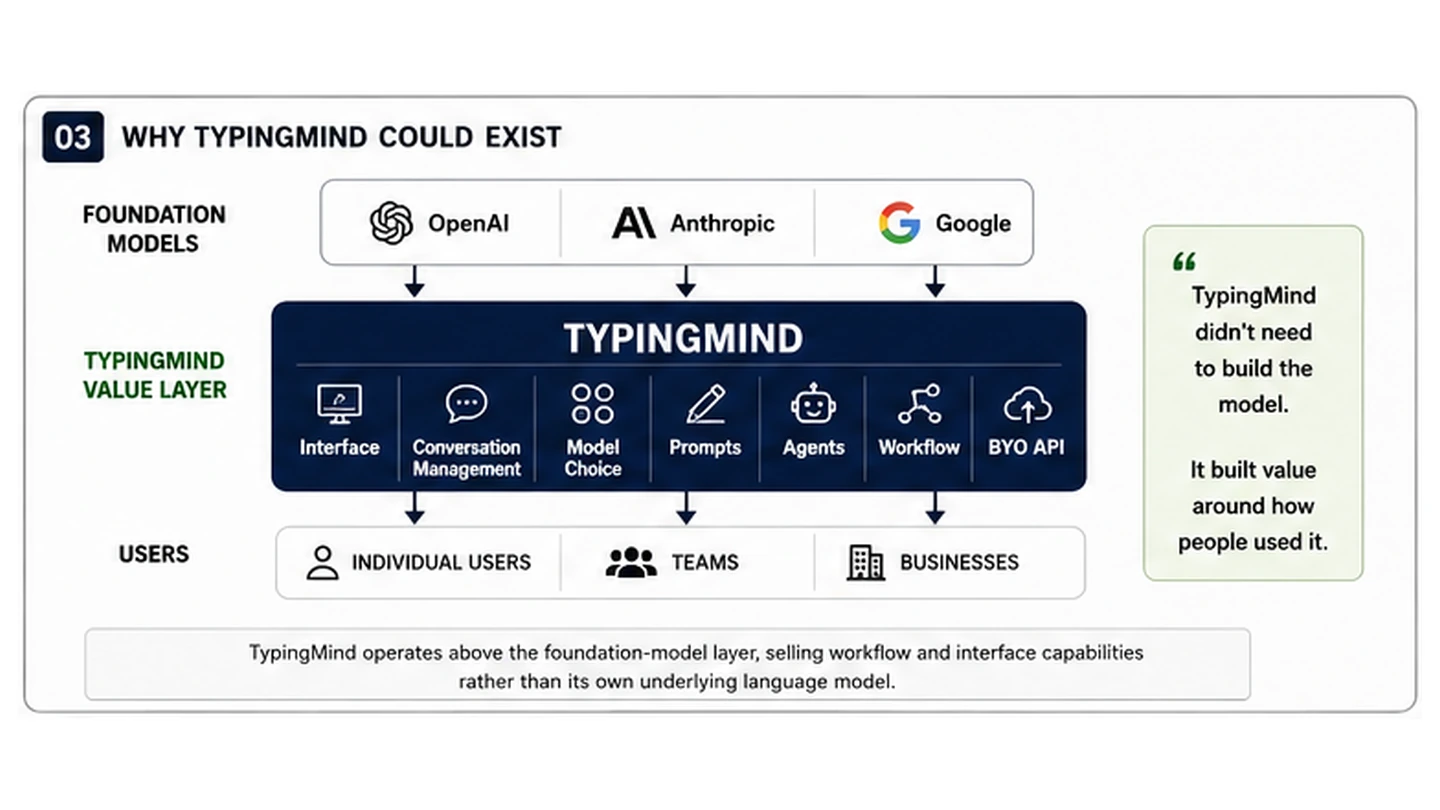
TypingMind does not primarily sell the intelligence generated by the underlying model. OpenAI, Anthropic, Google and other model providers supply that layer.
TypingMind sells the experience around those models.
For customers, the value can come from interface design, organization, workflow, model choice and control over how AI services are used.
That distinction explains how a paid product could emerge even when ChatGPT itself was already widely available.
A powerful foundational technology does not eliminate businesses around it. It can create new layers where companies compete over how the technology is accessed, managed and integrated into work.
2. It Started With a Problem Dinh Already Had
Dinh’s account of TypingMind’s origin is unusually direct.
He was using ChatGPT regularly and found parts of the original interface frustrating. He later mentioned repeated logins, response rendering and the lack of conversation search among the problems that pushed him toward building an alternative.
Then the technical environment changed.
On March 1, 2023, OpenAI opened API access to GPT-3.5 Turbo. Developers could now build their own products using the same model family associated with ChatGPT.
Dinh says the announcement immediately suggested a solution. Instead of waiting for somebody else to improve the interface he was already using, he could build his own.
He registered the TypingMind domain the following day.
The opportunity was not to reproduce OpenAI’s underlying technology.
It was to identify what remained unsolved around that technology.
3. The Weekend-Project Story Needs Context
TypingMind is often easy to frame as a product that appeared over a weekend.
That description captures the speed of the first build, but not the experience behind it.
Dinh had years of software-engineering experience and had already created several independent products before TypingMind. He had also experimented with AI products.
According to his own account, two earlier projects — EmojiAI and AskCommand — generated only about $100 combined, despite his already having roughly 50,000 Twitter followers.
TypingMind therefore did not emerge from somebody learning product development for the first time.
It came after previous products, previous failures, years of development experience and an audience built over time.
“Built over a weekend” describes the development period of the initial version.
It does not describe the amount of experience that made such a short development cycle possible.
4. He Shipped Before the Product Was Fully Formed
Dinh registered the domain on March 2 and spent the following days building.
According to his retrospective, he focused on completing a usable version over the weekend and publicly shared it on Monday, March 6.
The initial proposition was straightforward: a different interface for using ChatGPT through the API, with customers supplying their own OpenAI API keys.
Once the launch began attracting attention, Dinh added a paid option and reported his first sale later that day.
The sequence is more instructive than the raw development speed:
Build → Show → Observe → Charge → Improve
TypingMind was not designed as a fully developed commercial system before customers saw it.
Dinh continued adding features after launch and publicly shared those updates, allowing product development and distribution to reinforce one another.
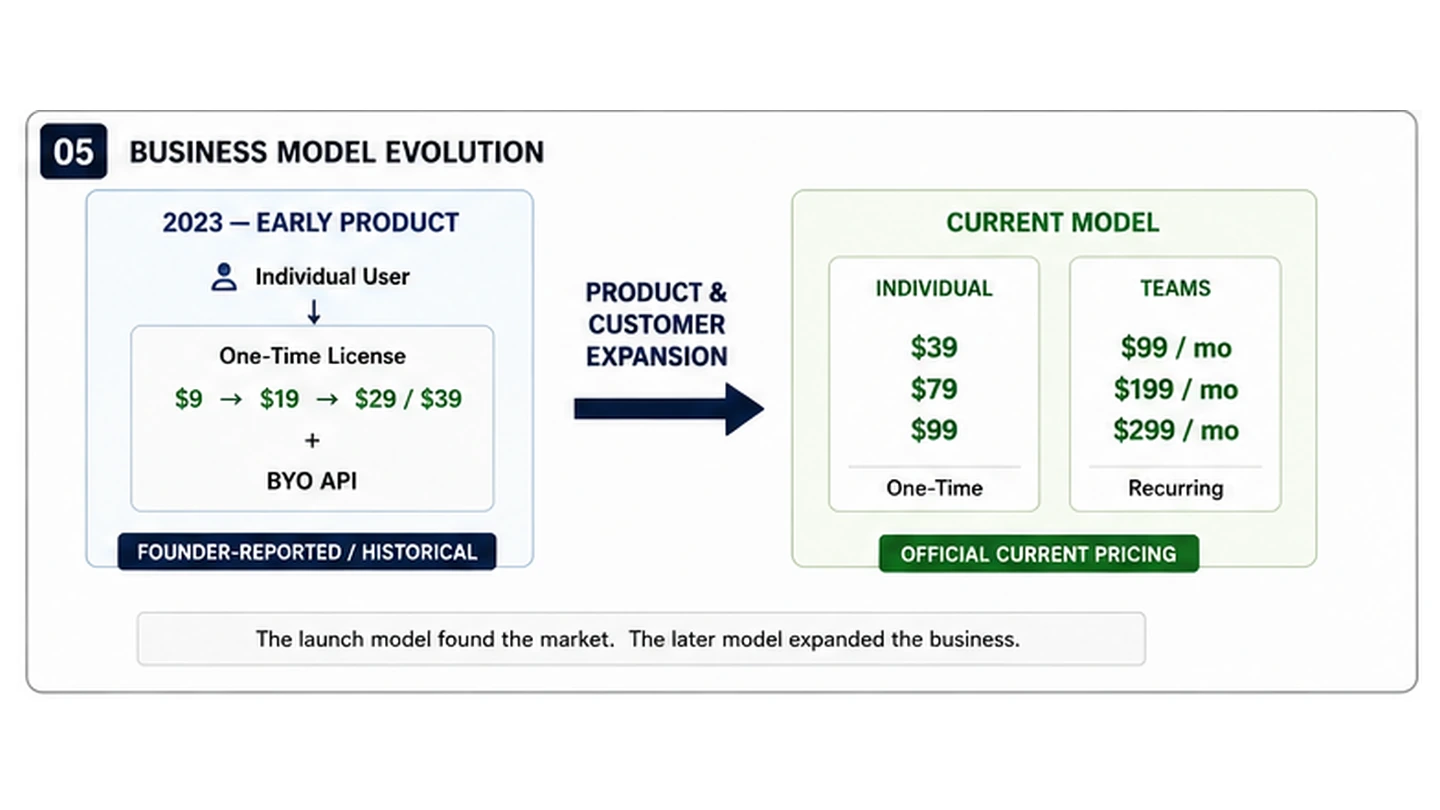
5. The First Paid Version Cost $9
According to Dinh, TypingMind’s first paid option cost $9.
As functionality increased, so did the price.
A March 10 newsletter advertised a $19 early-bird license, with plans to move to $29 around the Product Hunt launch and eventually $39.
The commercial structure was also different from another monthly AI subscription.
TypingMind charged customers for the software interface while allowing them to supply their own API keys and pay model providers separately for usage.
Dinh described the original product as a static web application without a conventional backend, server or database. In his interpretation, that architecture helped make one-time pricing practical because much of the variable AI cost remained with the customer.
The technical architecture is one claim.
Whether that architecture was a decisive cause of TypingMind’s success is another.
RevenueLore treats the latter as the founder’s interpretation rather than an independently established causal relationship.
6. The Early Revenue Was Fast — and Self-Reported
Dinh’s launch retrospective provides a detailed chronology of the first several days.
He reported cumulative revenue of approximately:
- $1K by March 7
- $2K by March 8
- $4K by March 9
- around $10K by March 10
- around $22K during the initial launch period
These are useful historical numbers because Dinh documented the process publicly.
They are not audited financial statements.
There is also a small discrepancy in his own reporting.
A newsletter published on March 10 said TypingMind had generated roughly $7,000, while his later retrospective said the product reached roughly $10,000 by March 10.
Those figures could have been recorded at different points during the same fast-moving day, but RevenueLore has not independently established that explanation.
We therefore classify the discrepancy as:
REQUIRES CONTEXT
Rather than choosing the larger figure, the more defensible conclusion is simply that Dinh reported several thousand dollars in revenue within days of the first sale.
7. Product Hunt Came After Traction Already Existed
TypingMind launched on Product Hunt on March 11, 2023 and finished #1 Product of the Day.
That ranking is independently visible in Product Hunt’s historical leaderboard.
Dinh’s retrospective associates the launch with another increase in attention and sales, eventually bringing his reported launch-period revenue to about $22,000.
But the chronology is important.
TypingMind already had paying customers and had generated thousands of dollars before its Product Hunt launch.
Product Hunt therefore did not create TypingMind’s first evidence of demand.
It gave additional exposure to a product that had already demonstrated some ability to convert attention into purchases.
8. The Bigger Launch Advantage Was Distribution
Dinh said around 99% of TypingMind’s earliest sales came from his Twitter reach.
At the time, he reported having roughly 76,000 followers.
Any version of the TypingMind story that leaves that out creates a misleading picture of the launch.
This was not an unknown developer releasing a product into an empty internet and hoping strangers would discover it.
Dinh already had a distribution channel. He had spent years publicly documenting products and building an audience around his work.
When TypingMind launched, he could immediately put it in front of tens of thousands of people who already knew who he was.
But his earlier experiments prevent this from becoming a simple audience story.
Dinh says EmojiAI and AskCommand performed poorly despite being launched after he had already accumulated roughly 50,000 followers.
The available evidence therefore supports a narrower interpretation:
His audience gave TypingMind a substantial distribution advantage, but audience reach alone did not guarantee commercial demand.
That statement is RevenueLore Analysis.
9. So Why Pay for TypingMind When ChatGPT Was Already There?
This is the central business question.
Dinh’s explanation focused on practical differences rather than better underlying intelligence.
He believed users valued features such as faster interaction, conversation search, reusable prompts and characters, the ability to bring their own API keys, and the absence of another mandatory monthly software subscription.
Those observations come from the founder, not from an independent customer survey.
They should not be treated as a measured ranking of why people purchased TypingMind.
But they make the product thesis clear.
TypingMind was attempting to improve using AI, not to create a smarter underlying AI model.
That leaves room for products to compete on things such as:
- interface design,
- conversation management,
- workflow,
- model choice,
- integrations,
- administration,
- privacy and deployment,
- cost control.
As foundational models become more capable, those surrounding layers do not necessarily disappear.
In some cases, they become more important because users must manage more models, more tools and more workflows.
10. The Business Survived the Launch
A strong first week does not tell us whether a product became a durable business.
By June 2023, Dinh reported that TypingMind was generating roughly $30,000 per month, including about $4,500 in recurring revenue.
He described Twitter and word of mouth as the main sales channels at the time.
Around the same period, he also reported that TypingMind had passed 4,000 paying users and that a business-oriented Custom Deployment offering was generating roughly $3,500 in MRR.
These figures remain founder-reported.
Appearing in an interview does not independently verify the underlying business accounts if the original source of the figure is still the founder.
What the numbers suggest, if Dinh’s reporting is taken as presented, is that the company had already begun moving beyond its original commercial structure.
The launch product was primarily:
Individual customer → one-time software purchase
A second model was beginning to emerge:
Business customer → recurring revenue
That transition eventually became an important part of TypingMind’s development.
11. The More Interesting Story Came After the First $22K
By November 2024, Dinh reported that TypingMind had generated $1 million in revenue over the previous 12 months.
RevenueLore classifies this number as FOUNDER-REPORTED.
Dinh described reviewing the company’s profit-and-loss figures, but RevenueLore does not have independently audited financial statements confirming the amount.
More interesting than the headline number is the change Dinh described in the revenue mix.
He said one-time licenses remained the largest individual revenue source but had fallen to roughly half of monthly revenue as Teams and other B2B activity expanded.
Dinh also described enterprise contracts that included one 3,000-seat deployment and several 1,000-seat deals.
Those deal sizes are also founder-reported.
If his account accurately reflects the business, TypingMind had evolved considerably from the inexpensive AI interface that launched in March 2023.
12. TypingMind Now Has Two Distinct Commercial Layers
At the time of RevenueLore’s August 2026 review, TypingMind’s public pricing showed two clearly different commercial structures.
Individual
The personal product listed three one-time licenses:
- Standard — $39
- Extended — $79
- Premium — $99
API usage was charged separately by the relevant model provider.
TypingMind’s own pricing page also displayed a claim of 20,641+ customers.
RevenueLore classifies that figure as COMPANY-REPORTED because it is published by TypingMind itself rather than independently audited.
Teams
TypingMind Teams used recurring subscriptions.
Official documentation listed:
- Starter — $99/month
- Growth — $199/month
- Professional — $299/month
with five seats included in the listed plans.
The Teams product also added business-oriented capabilities around administration, shared resources, access controls and customization.
The result is no longer a company defined by one revenue mechanism.
TypingMind combines:
One-time individual software revenue
with
Recurring business revenue
The business model that helped it find its first customers did not have to remain the model used to expand the company.
13. TypingMind Also Stopped Being Literally Solo
Dinh built the first version of TypingMind himself.
That part of the story is clear from his detailed account.
The later company should not be described in the same way.
Dinh began involving freelancers relatively early and later described working with a full-time employee and additional freelance developers.
By 2024, his updates also discussed enterprise customers, support work, sales conversations and team expansion.
The accurate framing is therefore:
TypingMind began as a solo-built product and evolved into a small-team business.
That is materially different from claiming that a single individual continued to operate the entire company alone as it grew.
14. RevenueLore Analysis — What Actually Made TypingMind Work?
No available source can reduce TypingMind’s outcome to one definitive cause.
The evidence instead points to several advantages that appear to have reinforced one another.
The founder understood the original problem firsthand
Dinh was not beginning with a hypothetical customer persona.
He was already using ChatGPT and wanted a better experience himself.
That did not prove that a market existed, but it gave him a concrete problem to solve immediately.
The timing was unusually favorable
TypingMind appeared within days of OpenAI opening API access to GPT-3.5 Turbo.
The platform change is independently verifiable.
Dinh’s ability to react quickly allowed him to build on a newly available technology while interest around generative AI was exceptionally high.
Years of experience were compressed into a short build cycle
The first version may have taken days.
The ability to build it did not.
Dinh’s software experience and previous products provide important context for how quickly TypingMind could move from idea to release.
Distribution existed on day one
Dinh’s reported audience of around 76,000 followers gave TypingMind immediate reach.
His claim that roughly 99% of early sales came through Twitter makes that advantage difficult to ignore.
The pricing was commercially distinct
A one-time software license combined with user-paid API usage did not look like another recurring consumer-AI subscription.
Available evidence does not allow RevenueLore to calculate how much that pricing choice contributed to adoption, but it clearly differentiated the offer.
The company allowed its model to evolve
Individual licenses established an early customer base.
TypingMind later added Teams and enterprise-oriented recurring revenue.
That progression may be the most important part of the case once the launch-week headlines are removed.
15. What Founders Should Not Learn From TypingMind
The easiest version of the story to remember is also the least useful:
Build an AI wrapper over a weekend and make $22,000.
Several important facts disappear in that version.
Dinh already had years of development experience.
He had shipped previous products.
He had experienced previous failures.
He had built a substantial audience.
And TypingMind appeared only days after a major platform change created a fresh technical opportunity.
The famous $22,000 figure is also founder-reported.
TypingMind therefore does not demonstrate that putting an interface around an AI API is an easy route to money.
It shows what can happen when experience, timing, distribution and a specific product problem align unusually well.
16. What Can We Actually Learn?
Several lessons remain useful after the headline is stripped away.
You do not always need to own the core technology
OpenAI supplied the original model.
TypingMind created value around how people interacted with it.
Some businesses compete not by owning the foundational technology, but by making that technology easier or more useful to apply.
Distribution changes what an MVP can accomplish
Launching to 76,000 followers is fundamentally different from launching to zero.
That advantage belongs near the center of the case, not buried in a footnote.
An audience creates leverage, not guaranteed demand
Dinh’s earlier AI products reportedly performed poorly despite an already substantial following.
Reach can put a product in front of people.
It cannot force those people to care.
Pricing is part of the product
TypingMind’s one-time-license model and BYO API structure were not merely billing decisions.
They influenced how customers compared the product with recurring AI subscriptions.
Speed is most useful when it creates feedback
The meaningful part of TypingMind’s rapid launch was not just that the first version appeared quickly.
Dinh could observe attention, decide to charge, add features and continue learning while the opportunity was still fresh.
The model that finds the market does not have to be the model that scales it
TypingMind began with individual licenses.
Its later development increasingly incorporated Teams and enterprise revenue.
That may be the most transferable lesson in the entire case.
17. Verification Notes
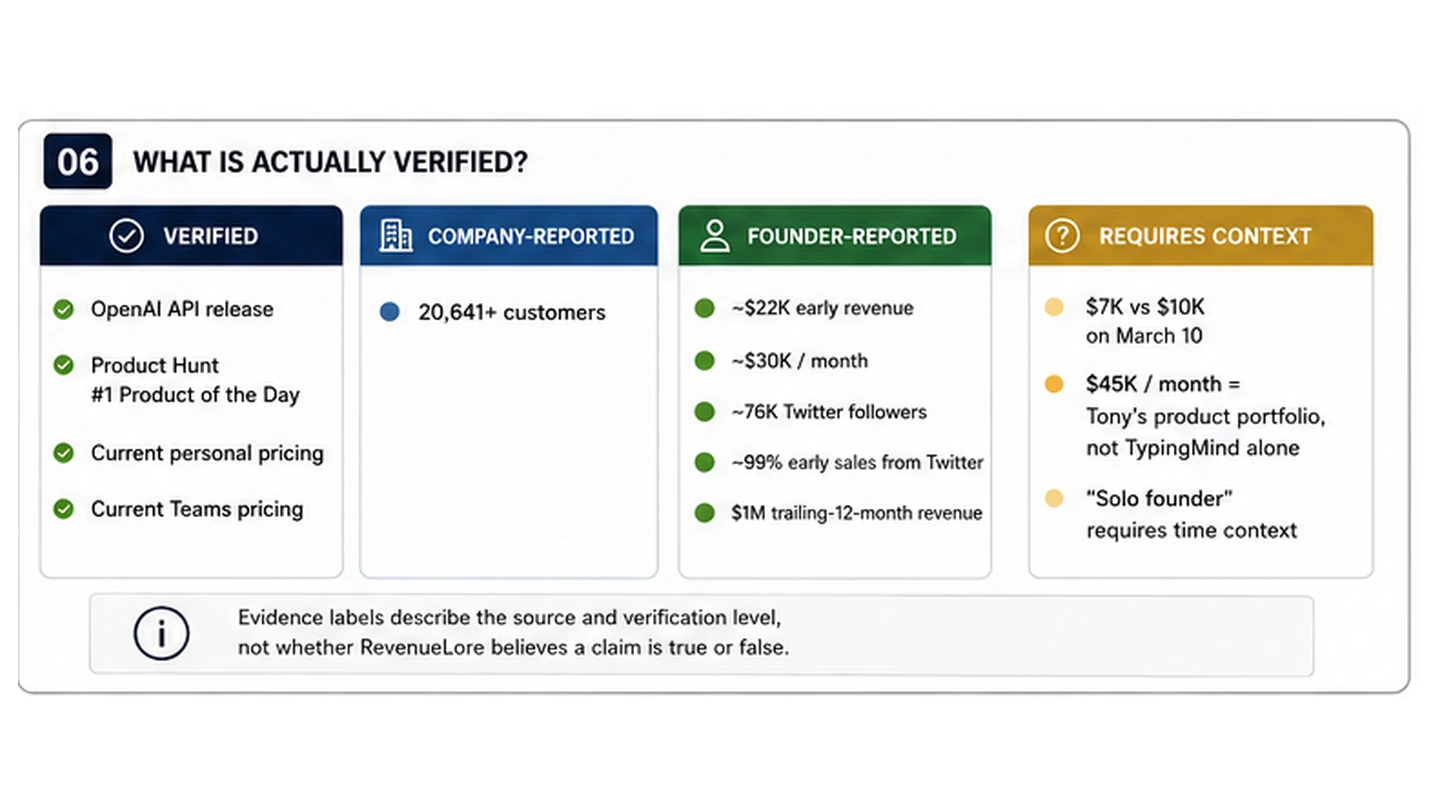
RevenueLore uses evidence labels to describe where a claim comes from and how independently it can be checked.
A FOUNDER-REPORTED label does not mean that RevenueLore believes a statement is false. It means that the claim has not been independently verified through audited accounts or equivalent evidence.
VERIFIED
OpenAI API release
OpenAI officially released API access to GPT-3.5 Turbo on March 1, 2023.
Product Hunt result
Product Hunt’s historical leaderboard records TypingMind as #1 Product of the Day on March 11, 2023.
Personal pricing at time of review
TypingMind’s official pricing materials listed $39, $79 and $99 one-time personal licenses.
Teams pricing at time of review
Official TypingMind documentation listed recurring Teams plans beginning at $99 per month.
COMPANY-REPORTED
20,641+ customers
TypingMind displayed this figure on its own pricing page at the time of RevenueLore’s review.
RevenueLore has not independently audited the underlying customer count.
FOUNDER-REPORTED
Important historical claims sourced primarily from Tony Dinh include:
- the initial $9 paid price,
- approximately $22K in early launch revenue,
- roughly 99% of earliest sales attributed to Twitter,
- approximately 76K Twitter followers around launch,
- approximately $30K/month in June 2023,
- approximately $4.5K in recurring revenue around that period,
- more than 4,000 paying users,
- $1M in revenue over the previous 12 months by November 2024,
- enterprise deployment sizes described in his later update.
These figures are not presented as independently audited financial results.
REQUIRES CONTEXT
March 10 revenue
A March 10 newsletter reported approximately $7K, while Dinh’s later retrospective said TypingMind reached approximately $10K by March 10.
Different reporting times could explain the discrepancy, but RevenueLore has not independently established that explanation.
The “$45K/month” figure
Dinh later discussed approximately $45K/month in revenue across his broader portfolio of products.
That figure did not refer to TypingMind alone.
RevenueLore does not use $45K/month as a TypingMind revenue figure.
“Solo founder”
TypingMind was initially built by Dinh alone.
Employees and freelancers became involved later, so descriptions of the business as “solo” require an early-stage time context.
RevenueLore Takeaway
TypingMind can be reduced to a sentence that is memorable but strategically misleading:
A developer built a ChatGPT wrapper over a weekend and made $22,000.
The fuller story is more useful.
An experienced developer had spent years building products and an audience. When OpenAI opened a new API, he recognized a problem he already understood, built quickly and could immediately place the product in front of tens of thousands of people.
The first sales suggested that users were willing to pay for something beyond access to GPT itself: a better layer around the model.
TypingMind then continued evolving.
What started as an inexpensive tool for individual users expanded into a broader AI workspace with both one-time individual revenue and recurring business revenue.
That makes the enduring lesson less about the first $22,000 than about where new businesses can emerge when a major technology platform creates a fresh layer for other companies to build on.
Primary & Key Sources
1. Tony Dinh — Making $22K in 7 days: the story
Launch timeline, early sales, founder reasoning, Twitter distribution and early product architecture.
https://news.tonydinh.com/p/making-22k-in-7-days-the-story
2. Tony Dinh — Early bird license of my new product
March 10 revenue snapshot and early pricing progression.
https://news.tonydinh.com/p/early-bird-license-of-my-new-product
3. Tony Dinh — Jun 2023: How I work with employees
Reported monthly revenue, recurring revenue, distribution and team development.
https://news.tonydinh.com/p/jun-2023-how-i-work-with-employees
4. Tony Dinh — My solopreneur story: zero to $45K/mo in 2 years
Founder background, previous products and the distinction between portfolio revenue and TypingMind revenue.
https://news.tonydinh.com/p/my-solopreneur-story-zero-to-45kmo
5. Tony Dinh — Nov 2024: My first million!
Founder-reported trailing-12-month revenue, B2B expansion and enterprise deals.
https://news.tonydinh.com/p/nov-2024-my-first-million
6. OpenAI — Introducing ChatGPT and Whisper APIs
Official confirmation of the March 1, 2023 GPT-3.5 Turbo API release.
https://openai.com/index/introducing-chatgpt-and-whisper-apis/
7. Product Hunt — March 11, 2023 Leaderboard
Independent record of TypingMind’s #1 Product of the Day ranking.
https://www.producthunt.com/leaderboard/daily/2023/3/11
8. TypingMind — Official Pricing
Personal-license structure, pricing at the time of RevenueLore’s August 2026 review and the company’s published customer-count claim.
https://www.typingmind.com/buy
9. TypingMind — API Key / Product Information
Product structure and BYO API positioning.
https://www.typingmind.com/apikey
10. TypingMind — Teams Documentation
Teams product structure and recurring pricing.
https://docs.typingmind.com/typingmind-team/getting-started/compare-typingmind-team-plans