Chatbase got attention almost immediately. Keeping customers was harder. Its more interesting story is how a simple “chat with your PDF” tool evolved into a customer-facing AI platform built around retention, self-serve growth, and enterprise sales.
Chatbase is easy to turn into a viral-startup story.
A university student with roughly 16 followers builds an AI tool. The product spreads. Revenue rises quickly. Three years later, the founder says the business has crossed $10 million in annual recurring revenue.
All of that makes for a neat narrative.
It is also incomplete.
Founder Yasser Elsaid has said Chatbase’s first-month churn was roughly 27%. So while the product attracted users quickly, a large share of them were not sticking around.
The churn figure shifts attention from the launch itself to what happened after Chatbase went viral.
The original “chat with your PDF” product expanded into customer-facing AI agents. Acquisition broadened beyond social sharing. The company retained a self-serve motion while adding enterprise sales.
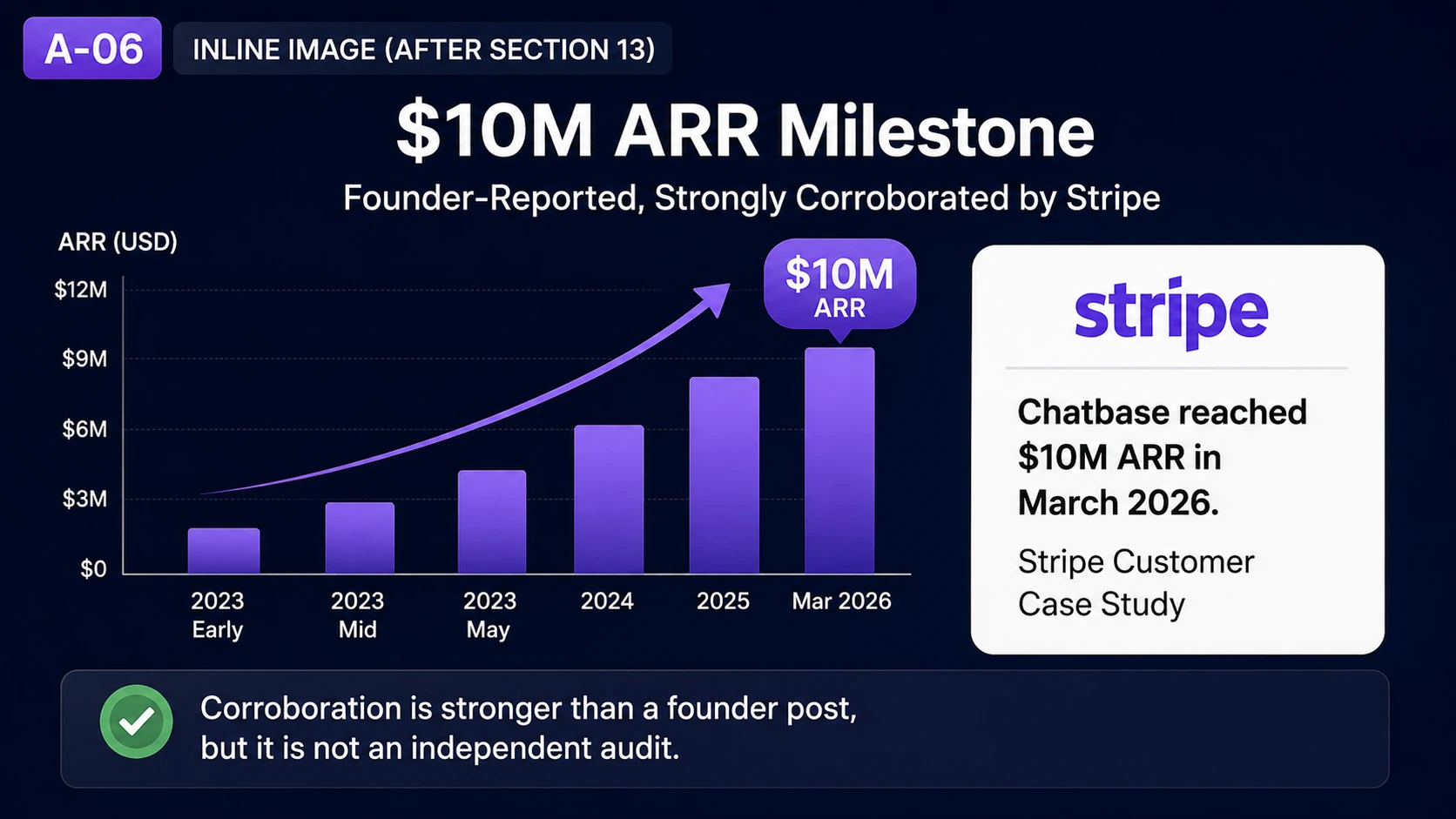
By 2026, Elsaid said Chatbase had reached $10 million in ARR, a milestone also reported by Stripe in a customer case study. RevenueLore treats the figure as founder-reported with strong third-party corroboration, not as independently audited financial data.
Chatbase’s story is therefore less about one successful launch than about a harder transition:
Turning attention into a business customers continued paying for.
Quick Snapshot
| Business | Chatbase |
| Founder | Yasser Elsaid |
| Category | AI Customer Support / AI Agents / B2B SaaS |
| Started | Early February 2023 |
| Initial Product | “ChatGPT for your PDFs” / chat with uploaded documents |
| Initial Audience | ~16 Twitter/X followers — founder-reported |
| Early Distribution | Viral social sharing, influencers, Product Hunt, Reddit, directories |
| May 2023 MRR | ~$64K — founder-reported |
| Early Retention Problem | ~27% first-month churn — founder-reported |
| 2026 Milestone | $10M ARR — founder-reported, strongly corroborated by Stripe |
| Current Product | Customer-facing AI agent platform |
| Current GTM | Self-serve + sales-led enterprise |
| Funding | Described as bootstrapped by founder and Stripe |
| Verification | Current product and pricing are directly observable; most historical operating metrics remain founder-reported |
The Short Version
Chatbase began with a simple proposition: upload a document and ask questions about it through a conversational AI interface.
Elsaid says he launched the product in early February 2023 while still at university and had only around 16 followers on Twitter/X.
The timing helped. ChatGPT had created enormous interest in conversational AI, and “talk to your PDF” was a product people could understand almost immediately.
Chatbase spread quickly.
Elsaid later reported that monthly recurring revenue climbed from effectively zero in early February to roughly $64,000 by May 2023.
But revenue was only one side of the story.
Elsaid has also reported first-month churn of roughly 27%.
Chatbase had found attention before it had found durable retention.
Over the following years, the company moved beyond the increasingly crowded PDF-chat category. The product expanded into customer-facing AI agents connected to business data, workflows and other systems.
The go-to-market model changed too. Viral social discovery was supplemented by organic acquisition, SEO, partnerships, self-serve growth and eventually enterprise sales.
By 2026, Elsaid said Chatbase had crossed $10 million in ARR. Stripe later reported the same milestone in a customer case study.
The headline is impressive, but the mechanism behind it is more useful.
The product that went viral was not the product that built the later business.
1. Chatbase Started With a Product Anyone Could Understand
The first version of Chatbase was much narrower than the company is today.
Elsaid described it as essentially “ChatGPT for your PDFs.”
A user uploaded a document. Chatbase processed it. The user could then ask questions through a conversational interface.
There was very little conceptual friction.
You did not need to understand embeddings, retrieval systems or language-model architecture to grasp the product.
Users could upload a PDF, ask a question and receive an answer.
That simplicity made Chatbase easy to demonstrate and easy to share.
It also meant the initial feature could become easy for competitors to imitate once the market noticed the opportunity.
2. Sixteen Followers Did Not Mean Zero Distribution
Elsaid says he had roughly 16 Twitter/X followers when he launched Chatbase.
That is an important part of the story, but it can also be misleading if presented without context.
Chatbase did not begin with a large owned audience. Unlike a founder who can immediately broadcast to tens of thousands of followers, Elsaid had very little direct reach.
What changed was the product’s ability to travel beyond that audience.
According to his account, Chatbase began spreading through social media, AI-focused accounts and people sharing demonstrations of the product.
He later used additional channels including Product Hunt, Reddit, Indie Hackers and AI directories.
Elsaid began with very little owned distribution, while Chatbase quickly earned reach beyond that initial audience through the channels described above.
3. Free Usage Helped the Product Spread
The earliest version of Chatbase was not launched with a fully mature commercial system.
Elsaid has said that users initially had broad free access and that he spent roughly $5,000 in OpenAI credits during an early free-distribution period.
He also built example bots around recognizable documents and public material.
That made the product easier to experience before somebody had to make a buying decision.
The logic was straightforward.
Instead of explaining what Chatbase might do, people could simply try it.
That reduced friction at exactly the moment when generative AI itself was still novel enough to attract attention.
Monetization came shortly afterward.
Different retrospective accounts describe the timing of the first paid customer differently, so RevenueLore does not treat an exact “30 minutes” or “two hours” as canonical.
Paid demand appeared quickly once monetization was introduced.
4. The Revenue Curve Moved Fast
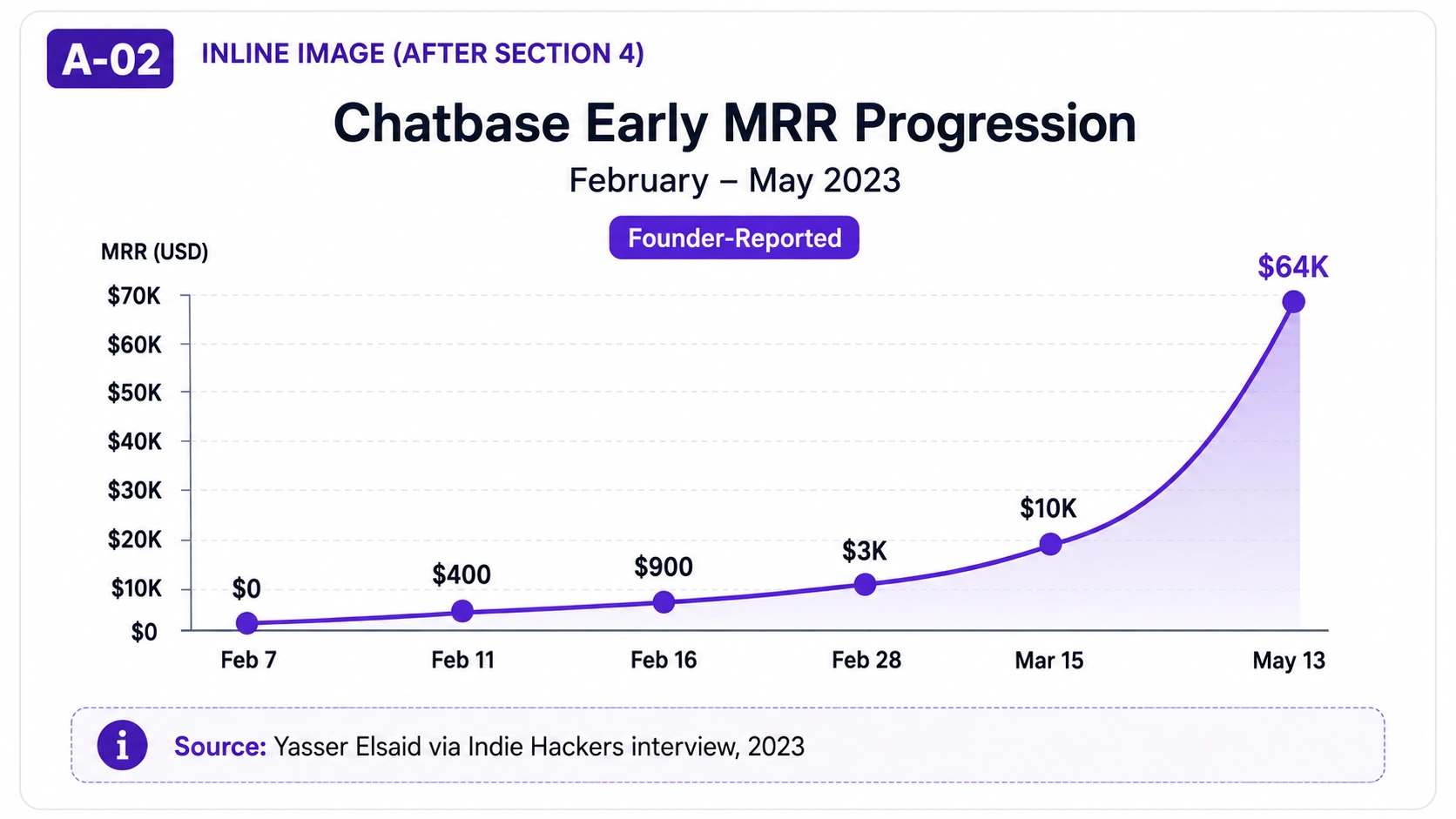
In a 2023 Indie Hackers interview, Elsaid provided a detailed account of Chatbase’s early recurring revenue.
He reported approximately:
- $0 MRR on February 7
- $400 MRR on February 11
- $900 MRR on February 16
- $3K MRR by February 28
- $10K MRR by March 15
- $64K MRR by May 13
These figures are FOUNDER-REPORTED.
RevenueLore has not reviewed independently audited financial records supporting the numbers.
The chronology nevertheless indicates that Chatbase was converting some social-media attention into recurring software revenue very quickly, according to Elsaid’s account.
But focusing only on the revenue curve would hide what may be the more revealing metric.
Churn.
5. The First-Month Churn Was About 27%
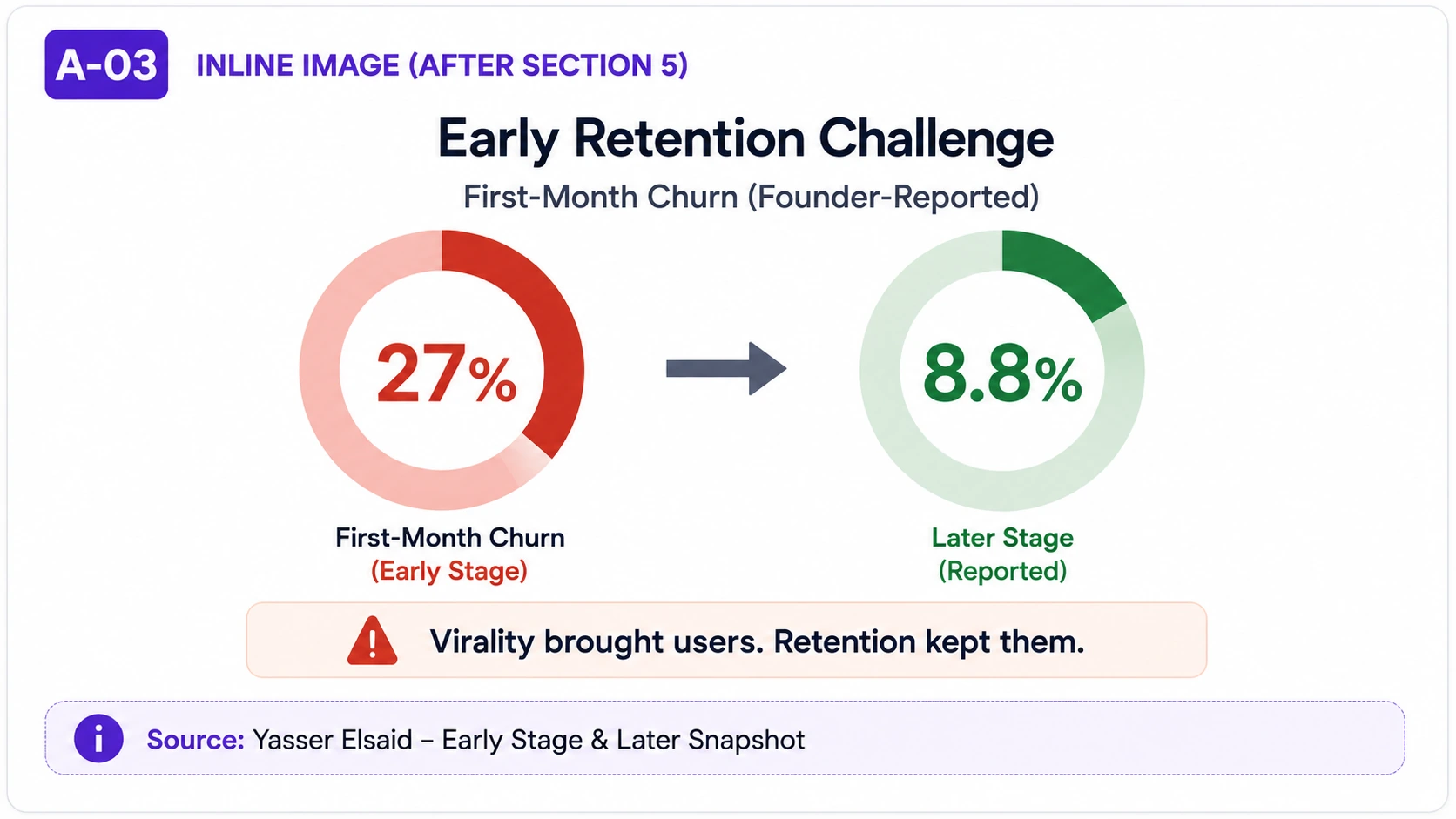
Elsaid later said Chatbase’s first-month churn was roughly 27%.
The churn figure complicates the launch narrative. Chatbase answered the acquisition question quickly, but the business would become durable only if enough customers continued paying.
Elsaid later reported materially lower churn, including a later snapshot of about 8.8%, and has attributed much of the improvement to focusing on product quality.
That explanation is the founder’s interpretation, not an independently established causal finding.
The sequence is more informative than any causal conclusion about why churn later changed.
RevenueLore Analysis
Virality solved Chatbase’s discovery problem before it solved its retention problem.
6. That Makes the Early “Product-Market Fit” Story More Complicated
Rapid revenue growth can make an early product look more settled than it really is.
Chatbase attracted attention, converted some of it into paid demand and grew revenue. Yet the founder-reported churn figure suggests that many early customers were not finding enough lasting value to remain. These observations are not contradictory: initial willingness to buy differs from long-term willingness to keep paying.
The early Chatbase story therefore looks less like:
Viral → customers → permanent product-market fit
and more like:
Viral → customers → retention problem → product improvement → broader use case
7. The Original Category Was Becoming Crowded
Being early helped Chatbase.
It did not prevent competitors from arriving.
Elsaid later described the “chat with your PDF” category as becoming increasingly crowded as generative-AI products multiplied.
The original feature was useful, but its novelty was becoming harder to defend.
Elsaid said he began looking for an opportunity with greater technical barriers and greater commercial value.
That pushed Chatbase toward businesses that wanted AI to interact directly with their customers.
The product began moving away from a standalone document utility and toward something embedded more deeply in business operations.
8. Chatbase Became a Customer-Facing AI Platform
Chatbase’s own retrospective describes the company moving from custom chatbots around data toward customer-facing AI agents.
That shift matters because the job of the software changed.
A document chatbot mainly needs to answer questions from supplied information.
A customer-facing business agent may need to do considerably more:
- understand company data,
- follow business instructions,
- answer customer questions,
- operate within guardrails,
- connect to external systems,
- trigger actions,
- work across different communication channels,
- and fit into existing support processes.
The product moved closer to the workflows businesses were already paying people and software to manage.
Chatbase was no longer only demonstrating what an LLM could do with a PDF.
It was trying to become part of how companies interacted with customers.

9. The Value Moved Above the Foundation Model
Chatbase does not need to create its own foundation model to sell AI software.
Its value sits above that layer.
The current product can combine external AI models with:
- company data,
- instructions,
- guardrails,
- integrations,
- actions,
- deployment channels,
- analytics,
- and management controls.
The underlying model generates intelligence.
Chatbase packages that intelligence into a business workflow.
RevenueLore Analysis
Chatbase became commercially more defensible as it moved from an easily copied document-chat feature toward workflows embedded in customer-facing operations.
That does not prove the pivot caused later revenue growth.
It does show that the product sold later was substantially broader than the product that originally went viral.
10. The Acquisition System Had to Mature Too
The product was not the only thing that changed.
Chatbase’s original distribution was unusually dependent on the momentum of the generative-AI wave and social sharing.
Elsaid has described additional early acquisition through channels such as:
- Product Hunt,
- Reddit,
- Indie Hackers,
- AI directories,
- and AI-focused influencers.
Later accounts include:
- SEO,
- content,
- partnerships,
- customer feedback loops,
- and broader organic acquisition.
By the time Stripe documented the company, Chatbase was operating a much more developed commercial system.
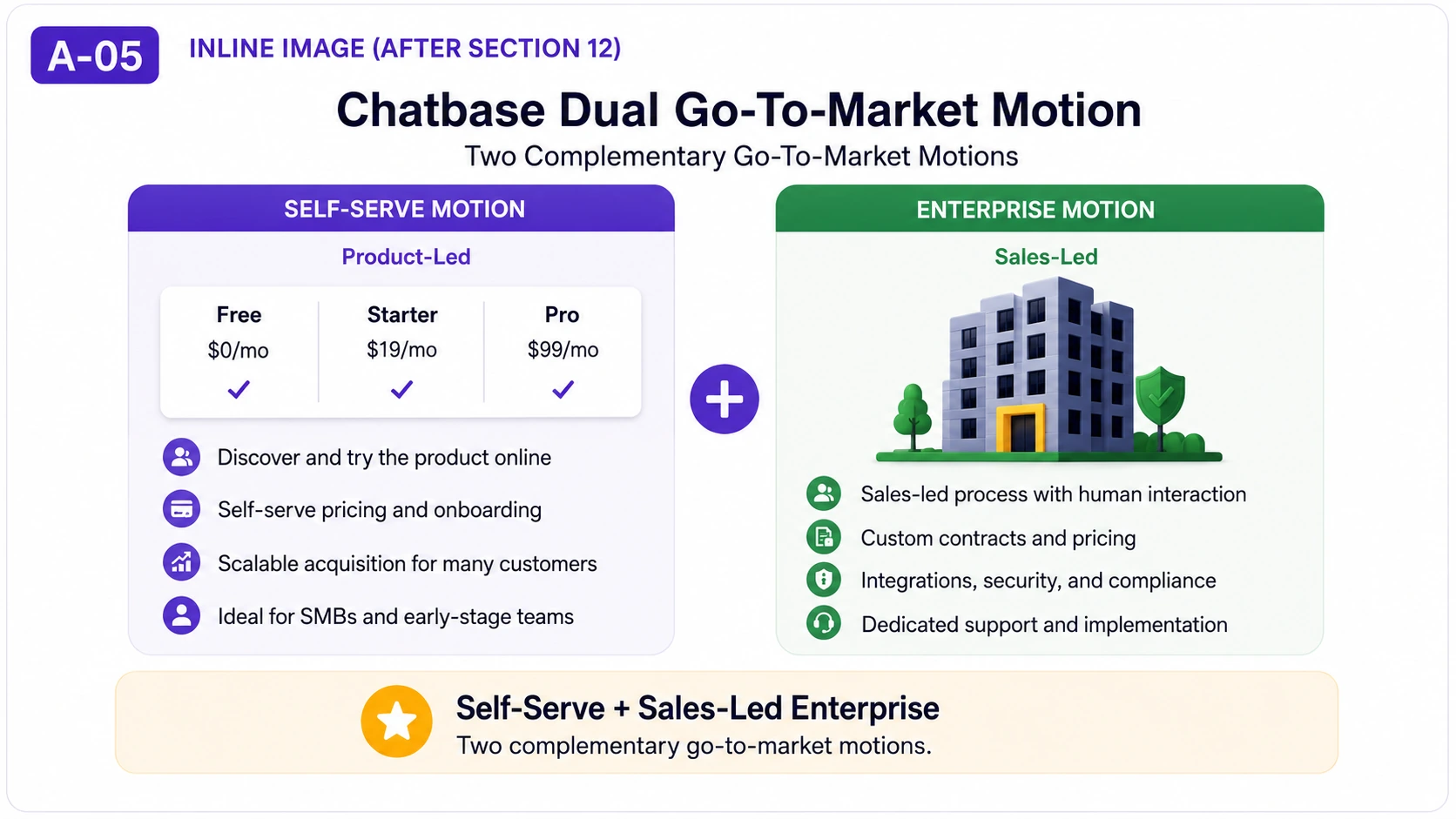
Stripe describes the company as combining high-volume self-serve with a sales-led enterprise motion.
That is a very different growth engine from a viral launch post.
11. Self-Serve Still Matters
Moving toward larger businesses did not require Chatbase to abandon its original software economics.
At the time of RevenueLore’s August 2026 review, the company still offered a public self-serve product ranging from a free plan through several paid tiers.
Customers can discover the product, try it and pay without first going through a traditional sales process.
That remains important.
Self-serve creates a scalable acquisition path for smaller customers and can reduce the cost of serving accounts that do not require complex procurement or implementation.
The later Chatbase business therefore did not simply replace its original model.
It added another one.
12. Enterprise Became the Second Motion
Larger organizations operate differently from self-serve customers.
They may require procurement, access controls, support, integrations, contractual commitments and additional implementation work.
That creates room for sales.
Stripe describes Chatbase as operating both:
high-volume self-serve
and
sales-led enterprise
This dual structure lets Chatbase serve two different commercial motions at once.
Self-serve
Customers can find, try and buy the product directly.
Enterprise
Larger accounts can move through a more involved sales process.
RevenueLore Analysis
Chatbase’s distribution evolved from viral founder-led discovery toward a broader combination of organic acquisition, product-led self-serve and enterprise sales.
13. The $10M ARR Number Is Strong — but Not Audited
Elsaid announced that Chatbase crossed $10 million in annual recurring revenue in 2026.
The claim has unusually strong corroboration for a private founder-led company.
Stripe also states in an official customer case study that Chatbase reached $10 million ARR in March 2026.
That matters because Stripe has a direct commercial relationship with Chatbase through payments, billing and related infrastructure.
But corroboration is not the same thing as an independent financial audit.
RevenueLore has not reviewed:
- audited financial statements,
- tax filings,
- bank records,
- or an independent accountant’s opinion confirming the figure.
The appropriate description is therefore:
Founder-reported $10M ARR, strongly corroborated by Stripe.
And one further distinction matters:
ARR is not profit.
14. The Company Did Not Stay Solo
Chatbase began as Elsaid’s project.
The later business did not remain a one-person operation.
Stripe reports that Elsaid was the company’s only employee until around June 2023 and that the team had grown to roughly 26 people around the company’s third year.
That progression matters because scaling the business created work beyond building the product itself.
Customer support, enterprise sales, integrations, partnerships, billing and operations all become organizational problems.
The accurate description is:
Chatbase began as a solo-built product and later became a small company.
Not:
One person built and operated a $10M ARR company alone.
15. RevenueLore Analysis — What Actually Changed?
Chatbase’s trajectory cannot be explained by a single factor.
Several things changed together.
The timing was unusually favorable
Chatbase entered the market when conversational AI was attracting extraordinary attention.
A product that would have required explanation a year earlier could suddenly be understood almost instantly.
The first product was highly shareable
“Talk to your PDF” was easy to show.
That helped Chatbase travel beyond Elsaid’s tiny initial audience.
Revenue arrived before retention was solved
Founder-reported MRR grew quickly while founder-reported churn remained extremely high; the two metrics can coexist.
The company did not remain attached to the original feature
As PDF-chat competition increased, Chatbase expanded into customer-facing agents and business workflows.
Distribution became broader
The company moved from launch virality toward a portfolio of organic and commercial acquisition channels.
The go-to-market model expanded
Self-serve remained useful, while enterprise sales created another path to revenue.
The product that found the first customers was not required to define the company forever.
16. What Founders Should Not Learn From Chatbase
The most misleading summary would be:
Launch an AI wrapper to 16 followers, go viral, and build a $10M ARR company.
That version removes almost everything that happened after launch.
It removes:
- the 27% founder-reported first-month churn,
- growing competition,
- the product shift,
- retention work,
- broader customer acquisition,
- enterprise sales,
- hiring,
- and several years of execution.
It also risks converting private-company revenue claims into audited facts.
Chatbase does not show that virality creates durable product-market fit.
It does not show that starting with almost no audience makes distribution irrelevant.
And it certainly does not show that rebuilding a 2023 PDF chatbot today would reproduce the same outcome.
17. What Can We Actually Learn?
Virality and retention are different problems
Attention gets people through the door.
Retention determines whether recurring revenue survives.
A successful first product can still lose strategic value
The feature that creates initial demand may become commoditized.
A company has to decide whether to defend it, deepen it or move somewhere more valuable.
Early revenue does not mean the product is finished
Chatbase’s founder-reported revenue and churn suggest that commercial demand appeared before the retention model was fully mature.
Distribution can change as a company grows
A channel that works at launch does not need to remain the only channel forever.
Moving up-market does not require abandoning product-led growth
Chatbase retained self-serve while adding enterprise sales.
The eventual company may look very different from the original MVP
The first product’s job is often to expose demand; the later company has to turn that demand into something repeatable and durable.
18. Verification Notes
RevenueLore separates publicly observable product facts from company claims, founder-reported metrics, strong third-party corroboration and editorial analysis.
VERIFIED / CURRENT PRODUCT FACTS
At the time of RevenueLore’s August 2026 review:
- Chatbase operated as a customer-facing AI-agent platform.
- It offered self-serve paid plans and an enterprise offering.
- It supported multiple external AI model providers.
- Its product incorporated business data, instructions and integrations.
- Stripe publicly identified Chatbase as a customer and described its billing relationship.
These describe directly observable current product or commercial infrastructure.
COMPANY-REPORTED
This category includes items such as:
- Chatbase’s official launch chronology,
- its own account of product evolution,
- customer-count claims published by the company,
- and current positioning statements.
A customer count published by Chatbase is not treated as an independently audited customer count.
FOUNDER-REPORTED
Important historical claims include:
- approximately 16 Twitter/X followers at launch,
- the early free-distribution strategy,
- roughly $5K in OpenAI credits,
- the early MRR progression,
- approximately $64K MRR by May 2023,
- approximately 27% first-month churn,
- later churn around 8.8%,
- intermediate ARR milestones,
- and the $10M ARR milestone.
These figures are not presented as independently audited financial or operational records.
STRONGLY CORROBORATED
$10M ARR
Elsaid reported that Chatbase crossed $10 million in ARR.
Stripe later included the same milestone in an official customer case study and has a direct commercial relationship with Chatbase through its payments and billing infrastructure.
RevenueLore therefore classifies the figure as:
FOUNDER-REPORTED + STRONG THIRD-PARTY CORROBORATION
not:
INDEPENDENTLY AUDITED
REQUIRES CONTEXT
Exact Launch Date
Chatbase’s official retrospective and later founder accounts use February 4, 2023, while an earlier interview records a February 2 public tweet.
RevenueLore therefore refers to the launch more broadly as early February 2023 unless discussing a particular source.
First Paying Customer Timing
Different accounts describe approximately 30 minutes and approximately two hours.
They may measure from different starting events, but RevenueLore has not established that explanation.
The exact number is therefore not used as a core claim.
MVP Build Time
Founder accounts describe roughly two months in one source and three months in another.
RevenueLore does not treat either as a precise canonical development duration.
RevenueLore Takeaway
Chatbase’s origin is the kind of startup story the internet likes to compress.
A university student with roughly 16 followers launches a simple AI product. It goes viral. Revenue arrives. A few years later, the founder reports $10 million in ARR.
The more revealing part of the story comes after launch: founder-reported first-month churn of roughly 27% suggests that early attention was not enough.
Chatbase had to improve retention, move beyond a rapidly commoditizing PDF-chat feature, become more deeply embedded in customer-facing workflows, expand distribution and build an enterprise sales motion without abandoning self-serve.
The viral launch created an opportunity, but it did not complete the business.
Attention can open the door. Retention, product evolution and distribution determine whether the company gets to stay.
Primary & Key Sources
1. Chatbase — From Chatbots to Smart AI Agents
Official company retrospective covering the original product and its evolution toward customer-facing AI agents.
https://www.chatbase.co/blog/from-chatbots-to-smart-ai-agents
2. Chatbase — Official Website
Current product positioning and AI-agent use cases.
3. Chatbase — Official Pricing
Current self-serve subscription structure and enterprise positioning.
https://www.chatbase.co/pricing
4. Indie Hackers — How a college student reached $64,000/mo in 6 months by being an AI first mover
Early founder interview covering product history, acquisition channels and founder-reported MRR progression.
5. Indie Hackers — From viral side project to a $5M/yr B2B AI platform
Follow-up founder interview covering product evolution, B2B expansion and later growth strategy.
6. Yasser Elsaid — Launch Retrospective
Founder account describing the early launch and small initial audience.
7. Yasser Elsaid — Early Free Distribution Retrospective
Founder account describing the initial free-distribution strategy and OpenAI-credit spending.
8. Yasser Elsaid — Churn Retrospective
Founder-reported early and later churn metrics.
9. Yasser Elsaid — $10M ARR Announcement
Founder announcement of the $10 million ARR milestone.
10. Stripe — Chatbase Customer Story
Third-party corroboration of Chatbase’s billing infrastructure, team evolution, dual go-to-market motion and $10M ARR milestone.