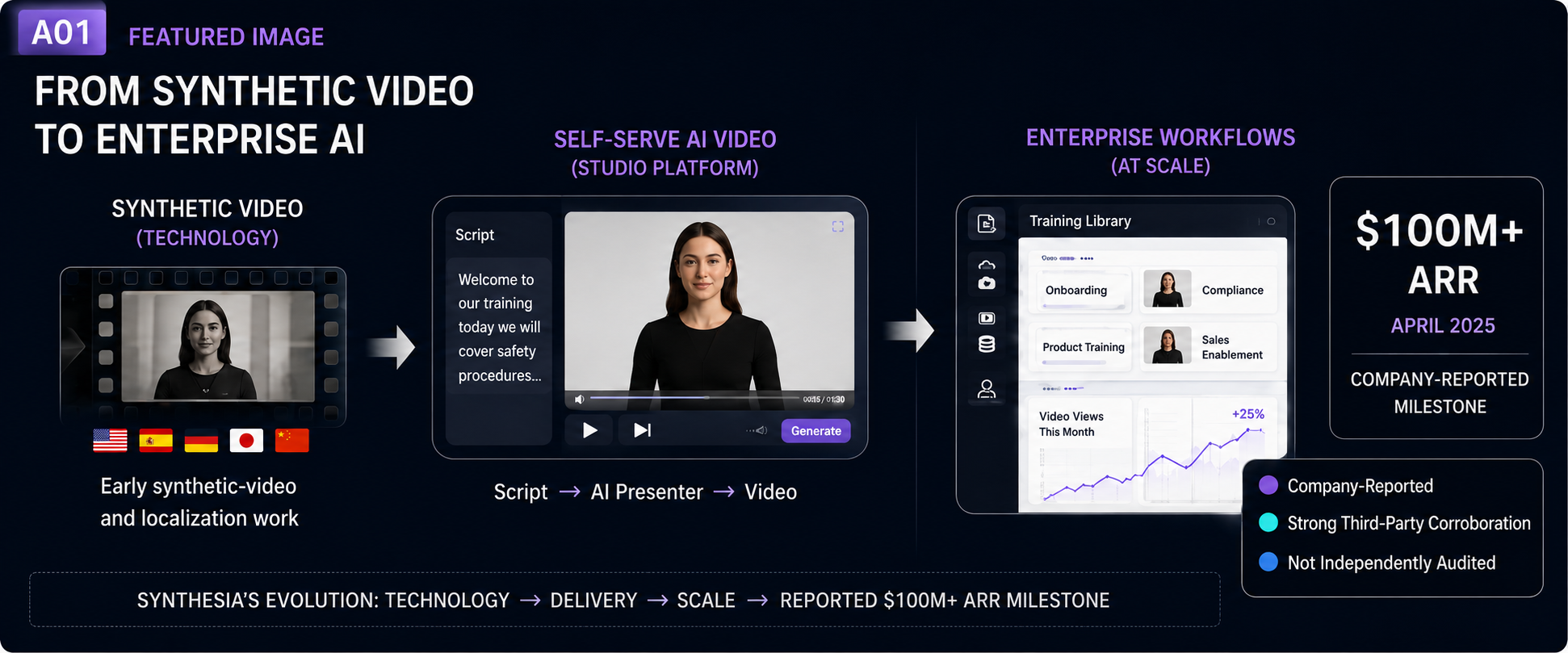
Synthesia was building synthetic video years before the generative-AI boom. Its bigger commercial opportunity emerged gradually as the technology became a self-serve product for training, onboarding and internal communication — eventually supporting a hybrid enterprise and self-serve business that reported more than $100 million in ARR.
Synthesia's story is easy to compress into the wrong version.
Today, the company is best known for software that lets businesses create videos with AI-generated presenters, voices and increasingly interactive learning tools. In April 2025, Synthesia said it had passed $100 million in annual recurring revenue. A company engineering retrospective published in February 2026 later described the business at approximately $140 million in ARR.
Those are substantial numbers, although they remain private-company financial claims rather than independently audited results.
The more interesting part of the story began much earlier.
Synthesia was founded in 2017, years before ChatGPT made generative AI a mainstream software category. Early versions of the company's technology focused on synthetic video, dubbing, localization and personalization. By 2019, Synthesia had commercial customers and was already exploring uses in advertising, marketing and e-learning.
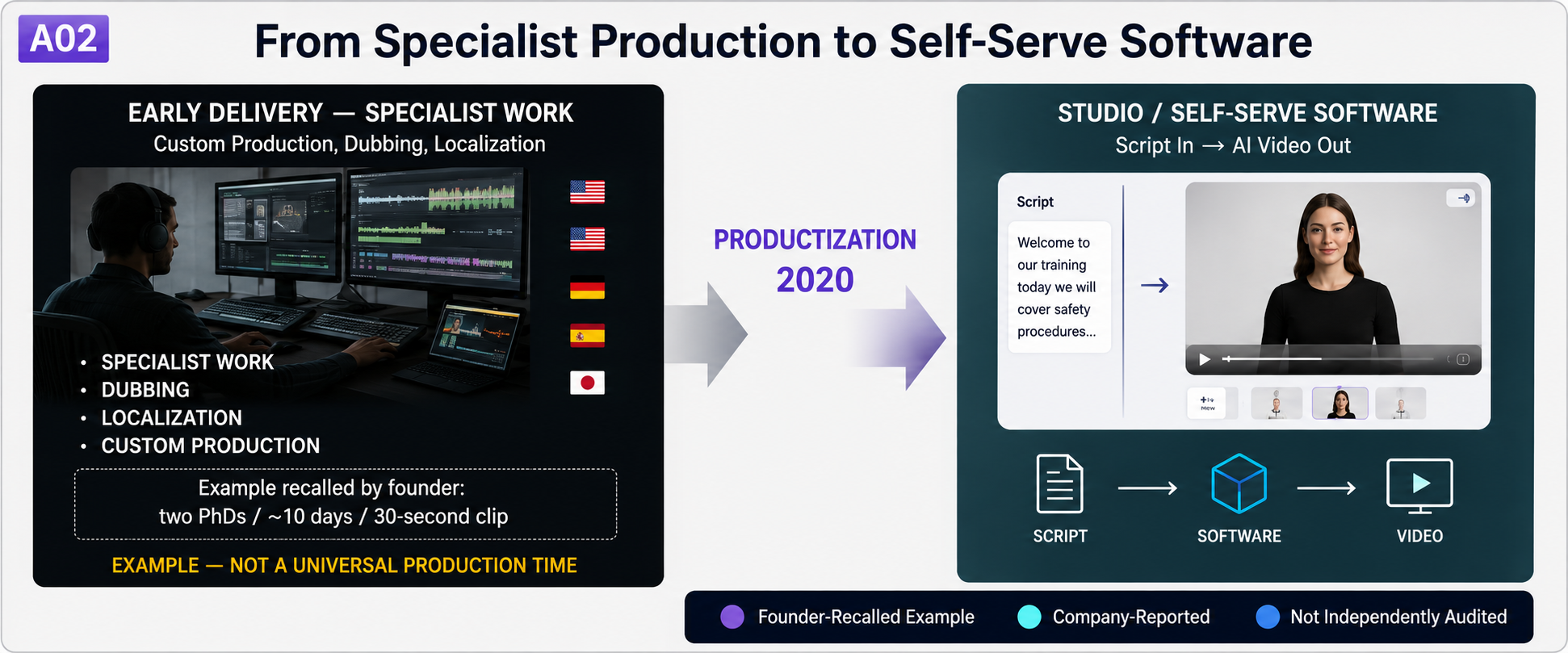
Founder Victor Riparbelli later described the early dubbing and translation business as mildly successful but relatively small and difficult to scale. In one example from that period, he recalled two PhD-level specialists spending roughly 10 days producing a 30-second clip.
The technology worked. Delivering it that way did not yet look like a large, repeatable software business.
What followed was not one clean pivot.
Synthesia gradually turned the underlying technology into a self-serve product. Its STUDIO product entered public beta in 2020, and by 2021 training, organizational education and internal communication were already visible enterprise use cases.
Something else changed as well: who was using the product.
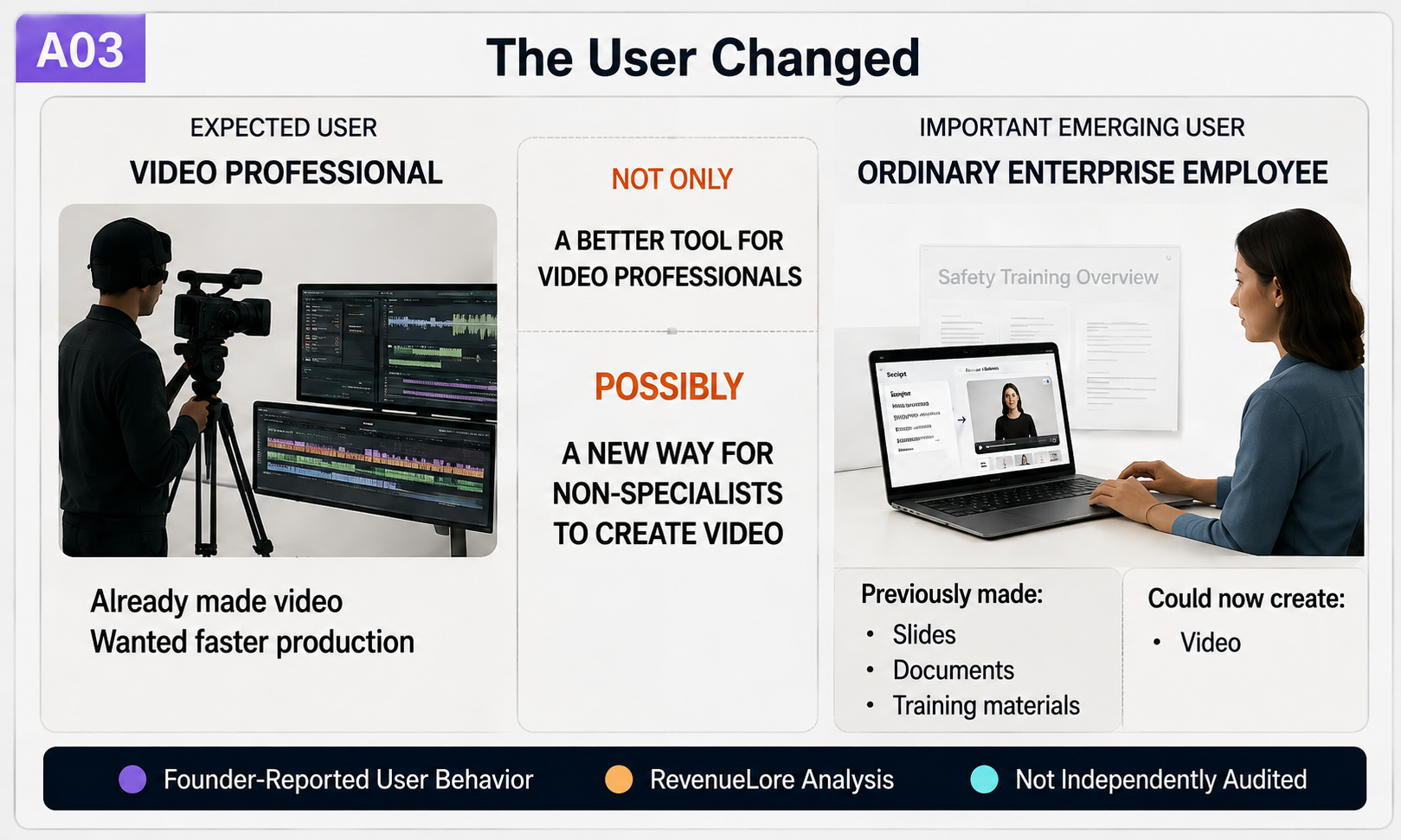
Riparbelli has said the team initially expected professional video departments to be among its most important users. Instead, some of the strongest usage came from employees who previously created PowerPoint presentations, Word documents and other forms of business content.
That distinction helps explain why Synthesia became more than an AI video demonstration.
The company was not only improving how video professionals worked. It was making video creation accessible to people who had rarely produced video at all.
From there, the business expanded across self-serve subscriptions, enterprise sales, broader collaboration workflows and eventually interactive learning products. By 2026, Synthesia was moving beyond the creation of training videos toward roleplay sessions in which employees could practice conversations with AI avatars and receive feedback.
The available evidence does not prove that any one product decision caused the company's later ARR growth.
It does show a business that spent years changing how a technology was delivered, who could use it and what recurring work it could perform inside an organization.
Quick Snapshot
| Business | Synthesia |
| Founders | Victor Riparbelli, Steffen Tjerrild, Matthias Niessner, Lourdes Agapito |
| Founded | 2017 |
| Category | Enterprise AI Video / Learning & Development / Visual Communication |
| Early Technology | Synthetic video, dubbing, localization and personalization |
| Early Commercial Position | Commercially real, but founder later described the early dubbing and translation business as relatively small and difficult to scale |
| Productization | STUDIO entered public beta in summer 2020 |
| Enterprise Shift | A multi-stage commercialization during 2020–2021 rather than one exact pivot date |
| Early Enterprise Uses | Training, education, onboarding and internal/company communication |
| Important User Shift | Founder reported that important users increasingly included ordinary employees rather than only video-production specialists |
| 2021 Scale | 1,000+ companies as users — company-reported through contemporary reporting |
| 2023 Scale | 50,000+ customers/businesses — founder/company-reported; definitions remain source-specific |
| Jan. 2025 Scale | Roughly 60,000 customers/enterprises and 1 million users — company-reported and treated as separate metrics |
| Apr. 2025 Scale | 65,000+ businesses and 70%+ of the Fortune 100 as customers — company-reported |
| Apr. 2025 ARR | More than $100M ARR — company-reported, strongly corroborated by third-party reporting, not independently audited |
| Feb. 2026 ARR | Approximately $140M ARR — company-reported, not independently audited |
| Revenue Model | Hybrid self-serve subscriptions + enterprise sales + usage-sensitive AI credits |
| AI Strategy | Application/workflow layer plus proprietary audio/video technology and selected external model dependencies |
| Series D | $180M in January 2025 at a $2.1B valuation |
| Series E | $200M in January 2026 at a $4B valuation |
| Current Product Direction | AI video creation expanding toward Courses, Agents, Roleplay and enterprise learning |
| Verification | Private-company ARR and customer metrics are not treated as independently audited |
The Short Version
Synthesia was already working on synthetic video long before the recent generative-AI boom.
Founded in 2017, the company developed technology for dubbing, localization and personalized video. By 2019 it had commercial customers and was exploring several potential applications, including advertising, marketing and e-learning.
Riparbelli later described that early business as mildly successful but difficult to scale. Producing synthetic video could still require considerable specialist work, limiting the extent to which the technology functioned like repeatable software.
The company gradually productized what it had built. STUDIO entered public beta in 2020, and enterprise education and training were already prominent use cases by the following year.
The customer behavior proved especially important. Riparbelli has said the company initially expected professional video departments to be core users. Instead, many important users were employees who had previously produced slides, documents or training materials rather than video.
That opened a different commercial possibility.
Instead of selling only a more efficient production tool to people who already made videos, Synthesia could give a much broader group of employees a way to produce video without a conventional studio, camera crew or editing workflow.
Training, onboarding and internal communication became recurring use cases. The business ultimately combined self-serve subscriptions with enterprise sales, while its product expanded from basic AI video creation into collaboration, localization and learning.
Synthesia said it passed $100 million in ARR in April 2025. That milestone has strong third-party corroboration but is not independently audited. A company engineering retrospective in February 2026 later referred to approximately $140 million in ARR.
By 2026, the company was also expanding into interactive roleplay, where users could practice workplace conversations with AI avatars and receive feedback.
Synthesia therefore presents a broader story than the rise of AI-generated presenters. The company spent years turning synthetic-media technology into a product that could fit ordinary, repeatable enterprise work.
1. Synthesia Started Before the Generative-AI Boom
Synthesia did not begin as a response to ChatGPT.
Victor Riparbelli, Steffen Tjerrild, Matthias Niessner and Lourdes Agapito founded the company in 2017, when synthetic media was still largely a specialist research and production field rather than a mainstream software category.
Early Synthesia technology could alter and localize existing video, including changing what a person appeared to say across languages. By 2019, contemporary reporting described applications in advertising, marketing and e-learning, alongside named corporate customers.
This matters for how the company's later growth should be interpreted.
Synthesia did not suddenly discover AI video after foundation models became popular. It had already spent years working on synthetic media and trying to determine where the technology could create commercial value.
The eventual enterprise business emerged from that longer period of technical development and experimentation.
2. The Early Business Was Real — but Difficult to Scale
The early Synthesia business was not a zero-revenue research project waiting to be rescued.
Riparbelli has described the company's work with film studios and advertising agencies on dubbing and translation as mildly successful. Customers existed, and the technology solved real production problems.
Its limitations were operational.
In a later interview, Riparbelli recalled an example in which two PhD-level specialists could spend roughly 10 days creating a 30-second clip. That should not be treated as the universal production time for every project, but it illustrates the amount of specialist work that could sit behind an apparently simple result.
The issue was therefore different from having no market at all.
Synthesia had technology that customers could use, but founder accounts suggest the service-heavy way of delivering that technology was difficult to expand into a much larger business.
The commercial challenge was to turn technical capability into something that could be repeated without recreating a custom production process every time.
3. STUDIO Changed How the Technology Was Delivered
Synthesia's STUDIO product entered public beta in the summer of 2020.
That represented more than a new interface.
A specialist production process was beginning to become self-serve software.
Users could work from a script and generate presenter-led video without assembling the traditional combination of cameras, actors, studios and editing resources associated with business video production.
The technology underneath the product still mattered, but the unit of value had changed.
Customers no longer needed to buy only a technical production service. They could interact with the technology directly.
For Synthesia, that meant each new customer did not necessarily require an equivalent increase in specialist production labor.
The company was moving toward a model that looked much more like software.
4. Enterprise Demand Was Already Emerging by 2020–2021
It is tempting to identify a single moment when Synthesia “pivoted” to enterprise training.
The available evidence is messier — and more useful.
STUDIO had already entered public beta in 2020. By April 2021, organizational education and training were explicit parts of the company's commercial positioning. Training videos and internal company updates were among the use cases being discussed publicly.
Riparbelli later recalled that large companies were also approaching Synthesia with problems around training and onboarding.
Taken together, the evidence points to a transition that unfolded across 2020 and 2021 rather than one decisive day when the company abandoned an old business and discovered a new one.
The distinction matters because Synthesia did not move from “no enterprise use” to “enterprise training” overnight.
Commercial demand, productization and customer behavior appear to have been converging over time.
5. The Important User Was Not Always a Video Professional
One of the most revealing details in Synthesia's early enterprise development concerns who actually used the product.
Riparbelli has said he initially expected professional video-production teams to be among the company's strongest users.
That expectation made sense.
If Synthesia was making video production faster and cheaper, people who already produced video would appear to be the most obvious customers.
But founder accounts describe an important group of power users elsewhere in the organization: people whose previous tools were more likely to include PowerPoint or Word.
They were not necessarily professional videographers looking for a more efficient video tool.
They were employees trying to communicate information.
Once video creation became accessible through software, they could choose video for work that previously might have become a slide deck, document or another static form of internal content.
That changed the market Synthesia could address.
6. Synthesia May Have Expanded Who Could Create Video
RevenueLore Analysis
The commercial significance of Synthesia may lie partly in the distinction between improving a professional workflow and expanding access to that workflow.
A product aimed only at existing video professionals competes inside an established production market. It can win by being faster, cheaper or technically better.
A product that enables non-specialists to create video changes the potential customer pool.
An HR employee preparing onboarding material, a manager creating internal training or a sales organization localizing instructional content might previously have avoided producing video because the process was too expensive or complicated.
Self-serve AI video lowered that barrier.
This does not prove that the expansion of the creator base caused Synthesia's later revenue growth.
It does suggest that the company was selling something broader than production efficiency. It was giving employees who had not previously been video creators the ability to use video as an ordinary business medium.
7. Training Was a Particularly Repeatable Use Case
Training and onboarding became prominent parts of Synthesia's enterprise business.
That is commercially notable because these tasks recur.
Companies hire new employees, change processes, update policies, train sales teams, introduce products and communicate across different locations and languages. The information itself may need to be reused and revised long after the first version is created.
Traditional video production can make those updates expensive.
Changing one process or translating a piece of material may require another recording, another edit or another production cycle.
Synthetic video can change that equation because much of the output is generated from software-controlled inputs.
RevenueLore cannot independently measure how much each of these characteristics contributed to Synthesia's adoption.
But training, onboarding and internal communication all create conditions in which editable, repeatable video can be more commercially useful than a one-off demonstration of AI technology.
8. Utility May Have Mattered More Than Cinematic Quality
RevenueLore Analysis
AI video companies are often evaluated by asking whether their output looks as good as traditionally filmed video.
That may be the wrong comparison for many of Synthesia's enterprise use cases.
A compliance lesson or internal onboarding module does not necessarily compete with a Hollywood production.
It may compete with a PowerPoint deck, a Word document, a screen recording or a video that the company never produced because the conventional process was too expensive.
Under that comparison, the economics change.
The question is no longer whether synthetic video is indistinguishable from premium human production. It becomes whether the output is useful enough, fast enough and easy enough to update for the task at hand.
Localization matters. So does repeatability. Editability can matter more than cinematic polish.
Synthesia's growth does not prove that these factors were individually decisive.
They do help explain why enterprise video can be valuable even when the goal is not to reproduce the production quality of film or advertising.
9. Customer Scale Grew — but the Definitions Changed
Synthesia has reported rapidly increasing adoption over time.
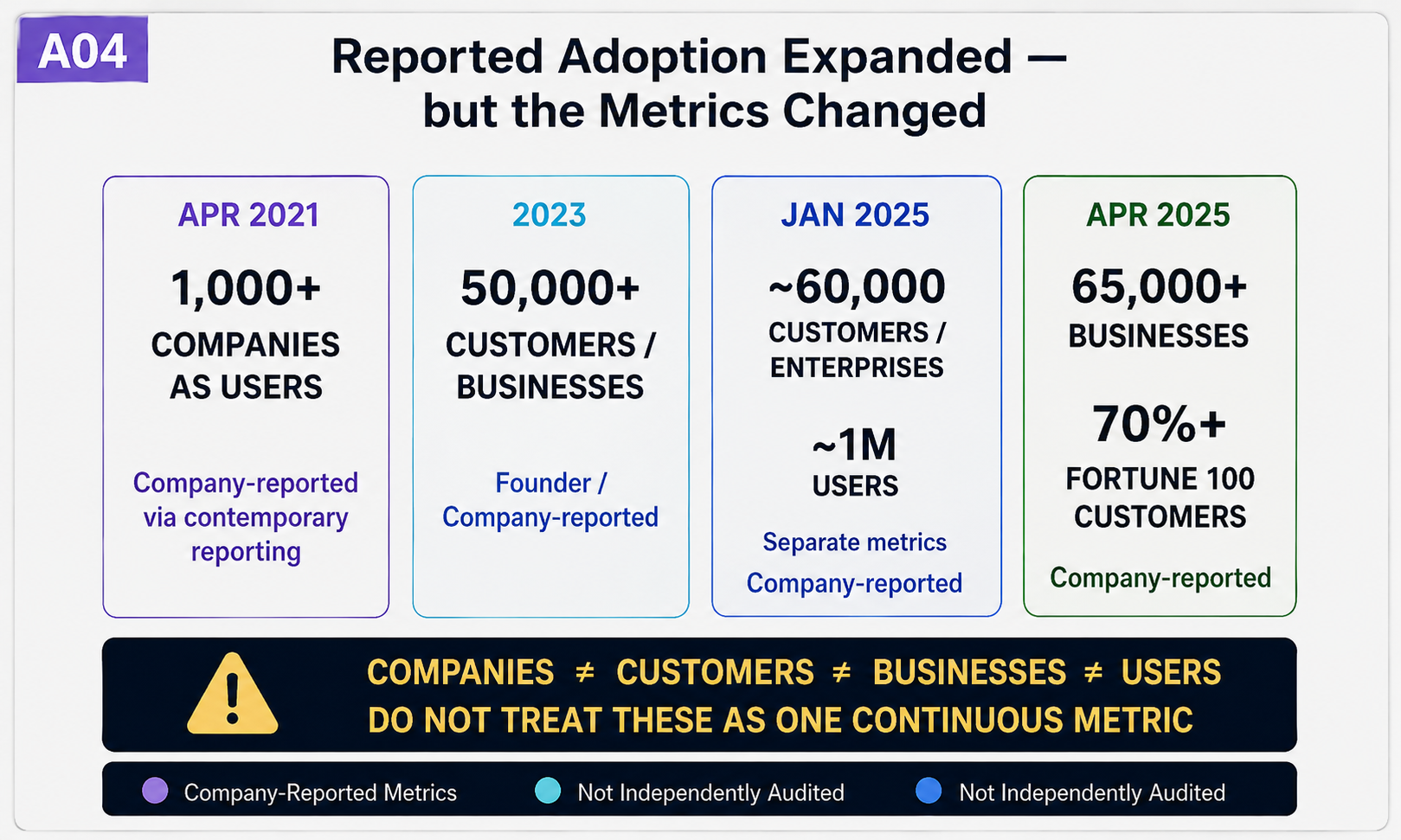
In April 2021, the company was described as having more than 1,000 companies using STUDIO.
By 2023, public figures had risen to more than 50,000 customers or businesses.
In January 2025, Synthesia-related reporting referred to roughly 60,000 customers or enterprises alongside approximately 1 million users. By April of that year, the company said more than 65,000 businesses were using the platform.
Those figures clearly describe a business that reported much broader adoption than it had several years earlier.
They should not be converted into a single perfectly comparable growth series.
“Companies,” “customers,” “businesses,” “enterprises” and “users” do not necessarily refer to the same unit.
A company with many individual users is not equivalent to many separate paying organizations. Likewise, the existence of an account does not tell us the size or value of the corresponding contract.
RevenueLore therefore keeps each metric attached to its date and source definition rather than drawing a false continuous customer curve.
10. Fortune 100 Adoption Is Strong — but Needs the Same Discipline
Synthesia has also repeatedly highlighted adoption among large companies.
The company and its founders reported that roughly one-third of the Fortune 100 used Synthesia in 2023. Company figures later increased to more than 60%, then more than 70% in 2025, and above 90% by 2026.
That progression is relevant evidence of reported penetration into large organizations.
It does not tell us everything about those relationships.
“Use” or “customer” can cover a wide range of deployments. A small team using Synthesia inside a Fortune 100 company is economically different from a company-wide contract.
Publicly available figures do not allow RevenueLore to treat every Fortune 100 reference as a large enterprise-wide deployment.
The safer conclusion is narrower: Synthesia reports that its technology has entered a substantial share of the world's largest companies.
11. Synthesia Built a Hybrid Go-to-Market Model
Synthesia eventually developed a commercial architecture that serves different types of buyers.
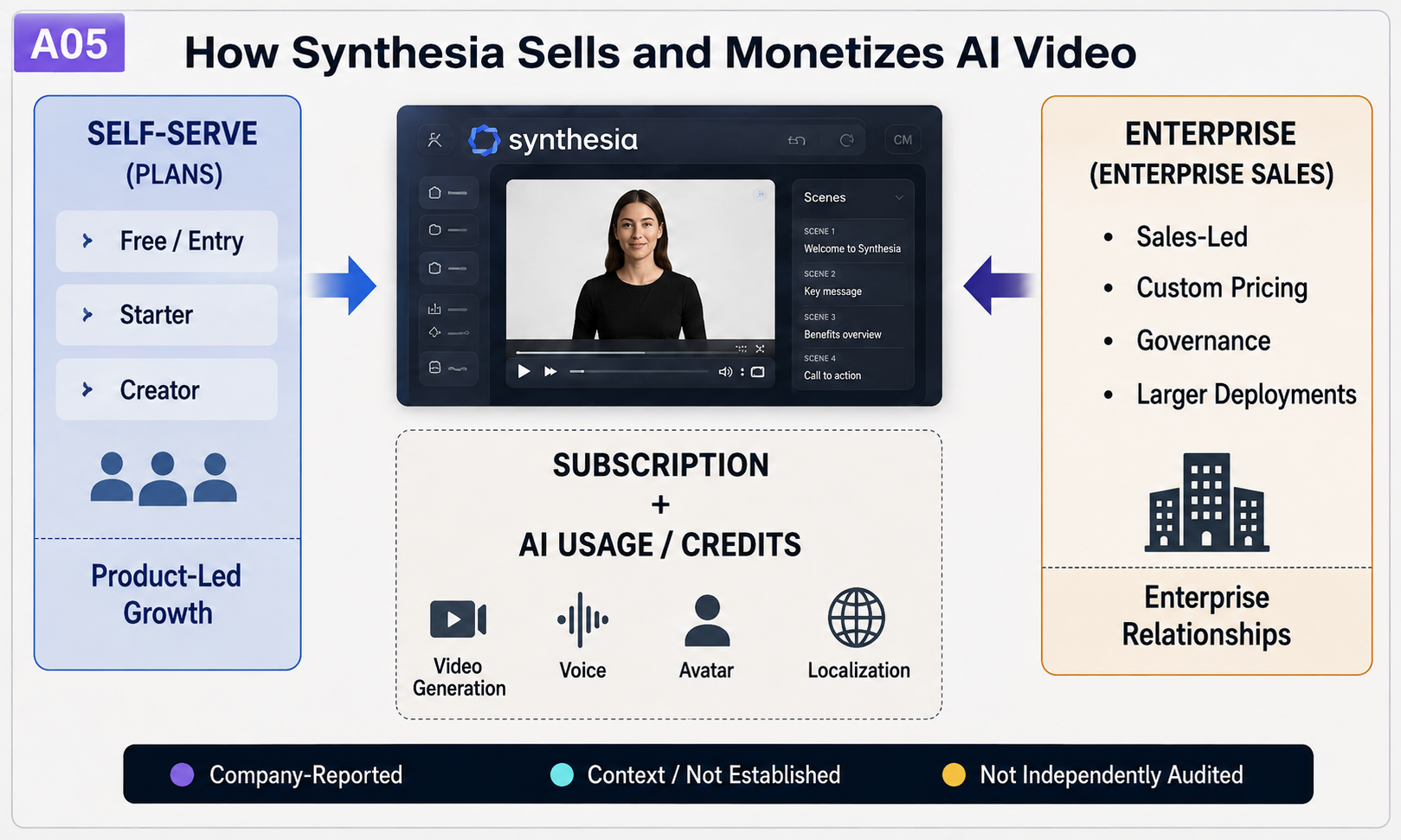
Its current product includes free and self-serve subscription tiers as well as a custom-priced Enterprise offering. Company material also describes sales-led customers, while the lower tiers allow smaller teams and individual users to begin without a negotiated enterprise contract.
That is a hybrid model.
The self-serve side reduces the friction required to try the product. Enterprise sales can support larger deployments with more complex purchasing, governance and organizational requirements.
The two channels do not have to compete with each other.
A user can encounter the product at one level while a larger organization buys it through another.
Public information does not establish what percentage of Synthesia's ARR comes from enterprise sales versus self-serve subscriptions.
The important point is that the company does not fit cleanly into either the pure product-led-growth or pure enterprise-sales category.
12. AI Economics Also Shaped Monetization
Synthesia's current pricing architecture combines subscriptions with credits that measure usage across AI capabilities.
That reflects a broader commercial reality of generative software.
Many traditional SaaS features can be provided to additional users at relatively low incremental computing cost. Generating AI media is different. Video, voice and other model-driven operations consume infrastructure and model resources.
The pricing architecture therefore has to account for more than access to software.
Customers may be paying for the right to use the product while usage itself also affects the cost of serving them.
RevenueLore does not need to rely on a snapshot of today's exact plan prices to make that distinction. Those prices can change.
The more durable observation is that Synthesia's business combines recurring software subscriptions with a usage system designed around AI consumption.
13. The $100M ARR Milestone Needs the Right Label
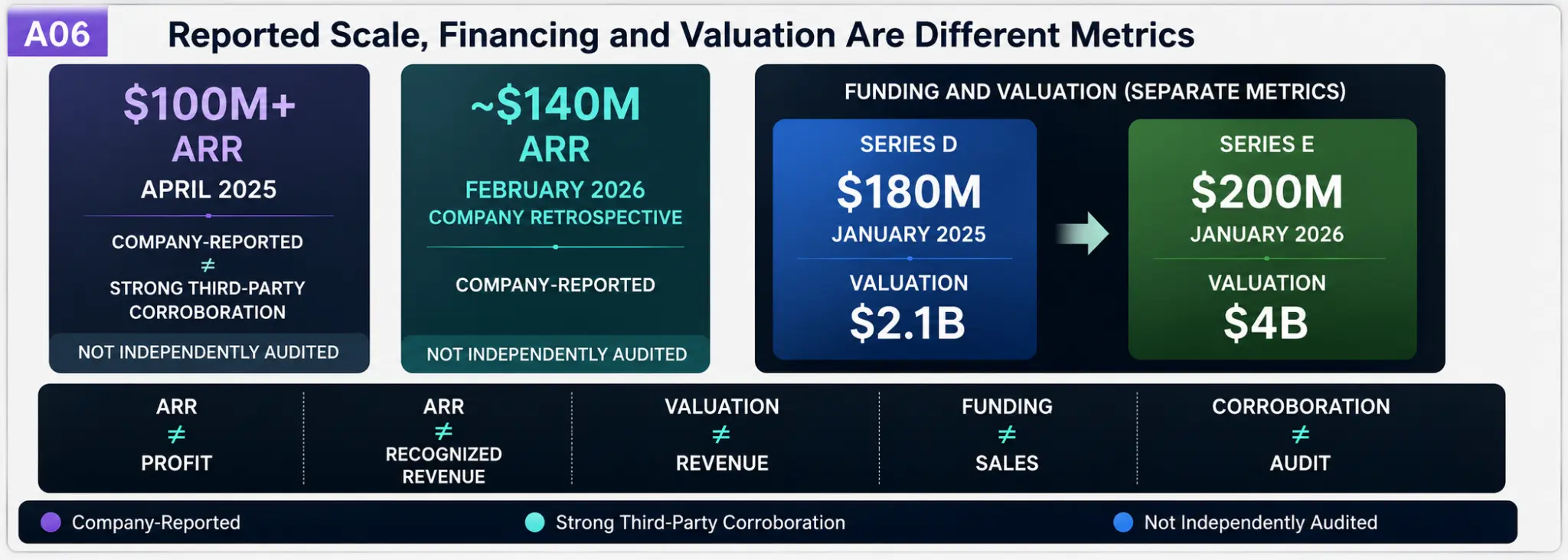
In April 2025, Synthesia announced that it had exceeded $100 million in annual recurring revenue.
The milestone has since been repeated in reputable third-party reporting, providing stronger corroboration than a company announcement on its own.
It remains a private-company financial claim.
RevenueLore has not reviewed independently audited financial statements confirming the figure.
The appropriate classification is:
COMPANY-REPORTED + STRONG THIRD-PARTY CORROBORATION — NOT INDEPENDENTLY AUDITED
The wording also matters.
ARR is a run-rate metric based on recurring revenue. It should not be automatically converted into the amount of accounting revenue recognized during a calendar year.
It is also not profit.
A company can have substantial recurring revenue while spending heavily on employees, computing infrastructure, sales, research and other operating costs.
The $100 million milestone tells us something important about Synthesia's reported commercial scale. It does not by itself reveal the company's net income.
14. The Later ~$140M ARR Figure Is Still a Company Claim
A Synthesia engineering retrospective published in February 2026 described the company as having scaled from roughly $40 million to approximately $140 million in ARR while its billing infrastructure evolved.
That provides another useful snapshot of reported revenue scale.
It does not turn the figure into independently audited financial data.
The same article is also evidence of a different kind: the company had to redesign internal billing systems to support a larger and more complex customer base, including sales-led relationships and evolving product usage.
That operational detail is useful.
What RevenueLore should not do is infer that the billing system itself created the revenue growth.
Infrastructure can enable a company to handle greater scale without being the reason customers bought the product.
The safer conclusion is that Synthesia's commercial systems had to mature as the reported business became larger.
15. Funding and Valuation Tell a Different Story
Synthesia has raised substantial outside capital.
The documented financing history includes a $12.5 million Series A in 2021, a $50 million Series B later that year, a $90 million Series C in 2023 and a $180 million Series D in January 2025.
The Series D valued the company at $2.1 billion.
In January 2026, Synthesia announced a $200 million Series E at a $4 billion valuation.
Those numbers tell us investors were willing to provide capital at increasingly high valuations.
They do not tell us how much revenue the company earned.
Funding is money invested into the company. Revenue comes from customers. Valuation represents the price investors assign to the company under a financing transaction.
None is interchangeable with the others.
A $4 billion valuation does not mean Synthesia generated $4 billion in revenue, just as a $200 million funding round does not represent $200 million of sales.
16. Synthesia Is Not Simply an AI Wrapper
Synthesia sits primarily at the application and workflow layer of the AI market, but describing it as a thin wrapper around external models would be inaccurate.
The company has spent years developing proprietary synthetic-media technology, including audio, video, avatar and voice systems.
At the same time, not every capability needs to come from a model owned by Synthesia.
For example, reporting around the company's Roleplay product identifies OpenAI as providing underlying reasoning intelligence for that experience.
This is increasingly common in AI application companies.
A product can develop proprietary models where those capabilities are strategically important while integrating external models elsewhere.
The commercial value can sit in the combination: media generation, interface design, workflow, collaboration, enterprise controls and the orchestration of different AI systems.
Synthesia does not need to own every model in its stack for that layer to matter.
17. The Product Expanded Beyond Video Generation
Synthesia's product has continued to broaden.
The company initially became known for turning text into presenter-led AI video. Later releases added more extensive collaboration, localization, recording and communication capabilities.
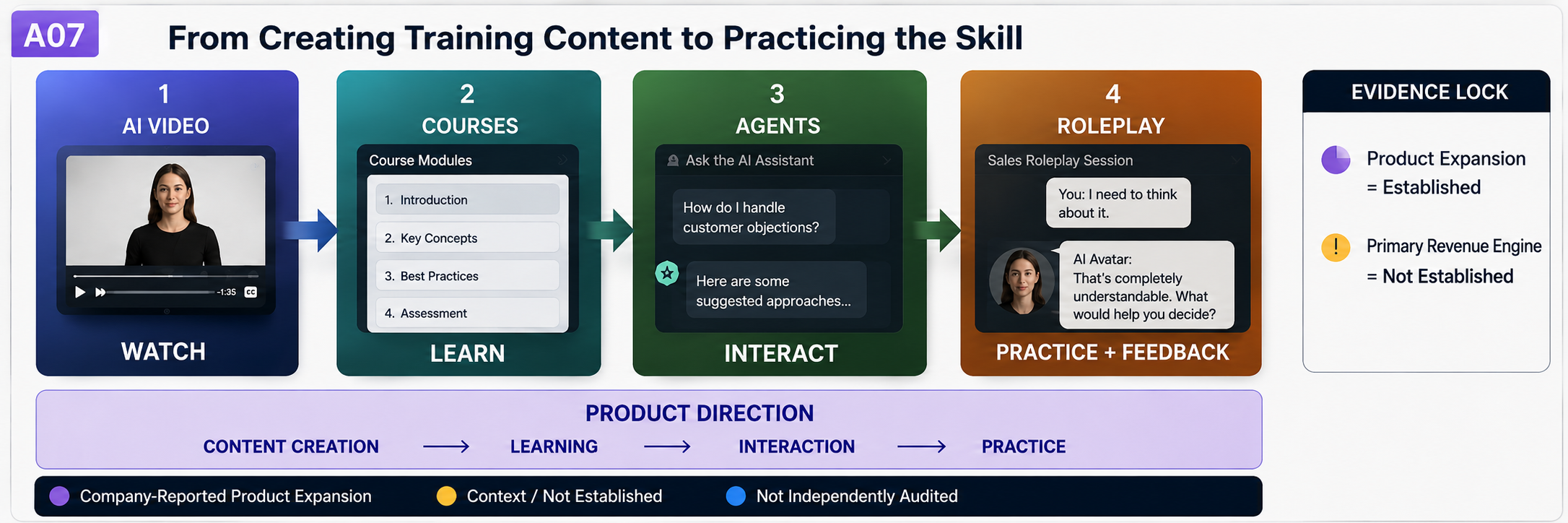
The direction became more explicit as Synthesia expanded into Courses, Agents and interactive learning features.
That matters because producing a training video is only one part of a training workflow.
Companies also need to organize content, deliver it, let people practice, evaluate understanding and determine whether employees can apply what they have learned.
Moving into those adjacent tasks gives Synthesia the opportunity to participate in more of the workflow surrounding the content it already helps customers create.
Whether those newer products become as commercially important as the video business remains to be seen.
18. Roleplay Changes the Product Question Again
In July 2026, Synthesia introduced Roleplay Sessions that allow employees to interact with AI avatars in simulated workplace conversations.
The use cases include scenarios such as sales conversations, leadership situations and customer interactions.
Instead of simply watching content, the user participates.
The system can then evaluate the interaction against defined criteria and provide feedback.
That shifts the product question.
Synthesia originally helped organizations create synthetic video. Its newer products increasingly ask whether AI can also participate in the learning process itself.
A company might move from creating a sales-training video to letting sales employees practice the conversation.
That is a meaningful product expansion.
It is not yet evidence that Roleplay has become Synthesia's principal revenue source, nor can a 2026 product release explain the company's earlier $100 million ARR milestone.
19. Trust and Safety Became Part of the Enterprise Product
Synthetic media has always carried an obvious risk: the same technology that can localize legitimate business video can also be used to impersonate people or create misleading content.
Synthesia's technology has appeared in reporting about misuse, including propaganda and false-news content.
The company has responded over time with consent requirements, moderation policies, customer and content controls, governance practices and enterprise security measures.
Those safeguards should not be treated as proof that misuse has been eliminated.
They are commercially relevant because trust becomes part of the product when organizations deploy synthetic media at scale.
Large enterprises do not only evaluate what an AI system can generate. They also have to consider who can generate it, whose likeness can be used, how content is governed and what controls exist around deployment.
For Synthesia, trust and safety therefore sit alongside technical capability as part of the enterprise product.
20. RevenueLore Analysis — What Actually Changed?
Synthesia's development is easier to understand as a series of commercial transformations than as one dramatic pivot.
The company began with synthetic-media technology.
Its early business used that technology through comparatively specialist production work. STUDIO moved more of the process into self-serve software.
The user base broadened. Professional video teams remained relevant, but employees who previously worked with slides and documents could now create video as well.
The job changed with them.
Training, onboarding and internal communication turned video into something organizations could create repeatedly rather than reserve for occasional high-production projects.
The go-to-market model expanded too. Synthesia developed both self-serve and enterprise sales paths.
The monetization architecture adapted to AI usage.
And the product itself began moving beyond video generation into courses, interactive agents and roleplay.
Taken together, these changes provide a stronger commercial explanation than the idea that Synthesia simply built increasingly realistic AI avatars.
The technology mattered, but the company progressively altered how it was delivered, who could use it and where it fit into enterprise work.
RevenueLore cannot independently determine how much of Synthesia's reported ARR growth came from model improvements, enterprise demand, sales execution, market timing, product expansion or greater usage among existing customers.
The evidence supports the transformation.
It does not support assigning the outcome to one cause.
What Founders Should Not Learn From Synthesia
Synthesia should not be reduced to a lesson about abandoning a failed first idea.
The early business was commercially real. Founder accounts describe it as limited in scale, not nonexistent.
Nor does the case show that a company can simply add an enterprise plan to an AI product and create a large business.
Synthesia spent years developing the underlying technology, productizing it, observing unexpected customer behavior, expanding recurring use cases and building multiple ways for customers to buy.
The company also raised substantial venture capital along the way.
None of those characteristics guarantees the same outcome for another startup.
The useful part of the case is not a formula.
It is the way the commercial interpretation of the technology changed over time.
What Can We Actually Learn?
Synthesia offers several more defensible lessons.
A technology can become a different business when the user changes.
The professional already performing a task is not always the largest potential customer. Sometimes the larger market comes from people who could not economically perform the task before.
Reducing production complexity can therefore create new creators rather than simply making existing production cheaper.
Recurring workflows can also matter more commercially than impressive demonstrations. A synthetic-media demo may attract attention, but training, onboarding and internal communication give customers reasons to return to the product.
Self-serve and enterprise sales do not have to be opposing strategies. They can serve different stages and sizes of customer demand.
AI application companies can also develop proprietary technology without owning every model in their stack.
Finally, product-market fit does not necessarily stop moving once a company reaches meaningful scale. Synthesia's expansion into Courses, Agents and Roleplay suggests that the company is still redefining what job its technology performs.
Verification Notes
RevenueLore separates observable historical and product facts from company claims, founder recollections, third-party corroboration and editorial analysis.
VERIFIED / CONTEMPORARY FACTS
Synthesia was founded in 2017 by Victor Riparbelli, Steffen Tjerrild, Matthias Niessner and Lourdes Agapito.
Contemporary reporting documents synthetic-video, localization and personalization activity by 2019, including commercial customers.
STUDIO entered public beta in the summer of 2020.
Enterprise education and training use cases were publicly visible by 2021.
Publicly announced funding rounds include the company's Series A, Series B, Series C, Series D and Series E.
Current product material documents a combination of self-serve and enterprise plans as well as newer interactive learning capabilities.
Roleplay Sessions were launched in 2026.
COMPANY-REPORTED
Synthesia's customer, business and Fortune 100 adoption figures are primarily company-reported.
These include:
- 50,000+ customers or businesses in 2023
- roughly 60,000 customers or enterprises and 1 million users in early 2025
- 65,000+ businesses in April 2025
- and the company's later Fortune 100 penetration figures
These metrics should remain attached to their original definitions and dates.
Synthesia also reported more than $100 million in ARR in April 2025 and approximately $140 million in ARR in a February 2026 engineering retrospective.
Neither figure is treated by RevenueLore as independently audited.
FOUNDER-REPORTED
Victor Riparbelli's later recollections provide important context on Synthesia's early business.
These include:
- the description of early dubbing and translation work as mildly successful
- the view that the early model was relatively small and difficult to scale
- the example involving two PhDs spending roughly 10 days on a 30-second clip
- unexpected enterprise demand for training and onboarding
- and the observation that important users often came from outside professional video-production teams
These recollections are useful historical evidence but are not treated as independent contemporary verification.
STRONG THIRD-PARTY CORROBORATION
Synthesia's April 2025 $100 million+ ARR milestone was announced by the company and subsequently repeated in reputable third-party reporting.
RevenueLore therefore classifies the milestone as:
COMPANY-REPORTED + STRONG THIRD-PARTY CORROBORATION
It remains not independently audited.
Third-party repetition does not convert a private-company financial claim into an audited result.
REQUIRES CONTEXT
The exact date of Synthesia's enterprise “pivot” cannot be reduced confidently to one event.
STUDIO was already being productized in 2020, enterprise training use was visible by early 2021 and founder retrospectives describe additional customer signals around the same period.
RevenueLore therefore describes the enterprise transition as a multi-stage commercialization across 2020–2021.
Customer metrics also require context because “companies,” “customers,” “businesses,” “enterprises” and “users” are not necessarily equivalent.
Fortune 100 adoption figures do not establish the size of every deployment.
The exact historical timing of the approximately $40 million ARR reference also requires context.
Current plan prices should not be projected backward as historical pricing.
REVENUELORE ANALYSIS
RevenueLore's analysis is that Synthesia may have expanded the business-video market by enabling employees who were not previously video professionals to create video directly.
The case also suggests that enterprise utility — including repeatability, localization and editability — may be commercially more important in some workflows than cinema-level production quality.
A further interpretation is that Synthesia's larger opportunity emerged as the technology moved from specialist production toward repeatable enterprise workflows.
Its later expansion into Courses, Agents and Roleplay may represent another shift, from creating learning content toward participating more directly in learning and skill development.
These are editorial interpretations.
They should not be read as independently established causal findings.
RevenueLore Takeaway
Synthesia did not turn synthetic video into a large software business through one clean pivot or one breakthrough model.
The company began with technology that already had commercial uses, but founder accounts suggest that delivering it through specialist production was difficult to scale.
Productization changed the economics.
Enterprise adoption changed the user.
Employees who once made slides and documents could now make videos without becoming professional video producers. Training, onboarding and internal communication gave those creators recurring reasons to use the product.
Synthesia then built a commercial system around that behavior: self-serve access, enterprise sales, usage-sensitive AI economics and a broader product that increasingly extends into interactive learning.
In April 2025, Synthesia said it had passed $100 million in ARR. A later company retrospective described approximately $140 million in ARR. Those figures are meaningful indicators of reported scale, but RevenueLore does not treat them as independently audited financial results.
The broader lesson is more durable than the headline number.
A powerful technology can become more commercially valuable when it stops being a specialist capability and becomes part of an ordinary workflow.
That does not prove that any one product, customer segment or go-to-market decision caused Synthesia's reported growth.
It does explain why the business that emerged looks very different from the technology experiment that came first.
Primary & Key Sources
1. TechCrunch — The startup behind that deepfake David Beckham video just raised $3M
2. TechCrunch — Synthesia's AI video generation platform hooks $12.5M Series A
3. TechCrunch — Synthesia raises $50M to leverage synthetic avatars for corporate training and more
4. TechCrunch — Synthesia secures $90M for AI that generates custom avatars
https://techcrunch.com/2023/06/14/synthesia-secures-90m-for-ai-that-generates-custom-avatars/
5. GV — Interview with Synthesia CEO Victor Riparbelli
https://www.gv.com/news/interview-with-synthesia-ceo-victor-riparbelli
6. TechCrunch — Synthesia raises $180M at a $2.1B valuation
7. Synthesia — $100M ARR milestone
https://www.synthesia.io/post/100-million-revenue-adobe-investment
8. TechCrunch — Synthesia hits $4B valuation
https://techcrunch.com/2026/01/26/synthesia-hits-4b-valuation-lets-employees-cash-in/
9. Synthesia — How we scaled our billing system from $40M to $140M ARR
https://www.synthesia.io/post/how-we-scaled-our-billing-system-from-40m-to-140m-arr
10. Synthesia — Pricing
https://www.synthesia.io/pricing